Glass & substrate science
Alkali-Free Glass as Encoder-Disc Substrate: Low Expansion, No Sodium and As-Drawn Surface
Display-panel alkali-free aluminoborosilicate glass has a CTE of about 3–4×10⁻⁶/K, almost no sodium and a high strain point. This article compares it with soda-lime and borosilicate glasses, calculates the expansion mismatch and hole-edge stress against aluminium-alloy and stainless hubs, and explains which encoder discs it suits and what to watch in bonding and assembly.
Display-panel alkali-free aluminoborosilicate glass has three traits: a CTE of about 3–4×10⁻⁶/K, almost no sodium, and a high strain point. Those three map directly onto encoder-disc pain points: thermal stress between the chrome film and the substrate, alkali exudation that causes haze and corrosion, and dimensional shrinkage on bake. There is a cost: its CTE is even farther from common metal hubs. This article works both sides with example numbers.
Comparison with other glasses
Typical ranges (examples, not tied to any brand):
| Class | α (10⁻⁶/K) | Strain point (℃) | Na₂O (wt%, order of magnitude) |
|---|---|---|---|
| Soda-lime | 8.6–9.4 | about 500–520 | about 14 |
| Alkali aluminosilicate | 7.5–9.5 | about 530–585 | about 12–14 |
| Type 3.3 borosilicate | about 3.3 | about 510 | about 4 |
| Alkali-free aluminoborosilicate | 3.2–3.9 | 650–750 | about 0 (usually < 0.1) |
| Fused silica | about 0.5 | about 900–1100 | 0 |
Alkali-free glass has an α close to borosilicate but a strain point about 140–240 K higher – its first advantage.
Thermal stress. Chrome film α is about 4.9×10⁻⁶/K; take bulk E = 279 GPa and Poisson’s ratio 0.21. On a 100 K substrate rise, the chrome on soda-lime is put into tension by about 145 MPa; on alkali-free glass it becomes compression of about 42 MPa order. Sputtered films already carry hundreds of MPa of intrinsic stress, so thermal stress matters mainly in temperature cycling and high-temperature steps, but a mismatch one order smaller still helps adhesion.
Dimensional stability. With the example parameters of the thermal-shrinkage article in this library, a 400 ℃ bake for 1 h shrinks soda-lime by about 92 ppm and alkali-free by about 0.006 ppm. Prefer alkali-free for high-temperature steps (thermal cure, anneal, high-temperature coating).
No sodium. In damp heat, sodium ions in soda-lime migrate outward and form an alkaline water film that can corrode chrome at pinholes and leave white haze – a common mechanism; alkali-free glass almost has no such path. “Alkali-free” is not “immune to everything”: acid and hot-alkali resistance still differ, and cleaning baths must be validated with your process.
As-drawn surface. Overflow-downdraw sheet never touches a forming member; roughness can reach the sub-nanometre class (see the substrate-comparison article in this library), needs no polish, and is usually supplied thin.
Expansion mismatch with metal hubs
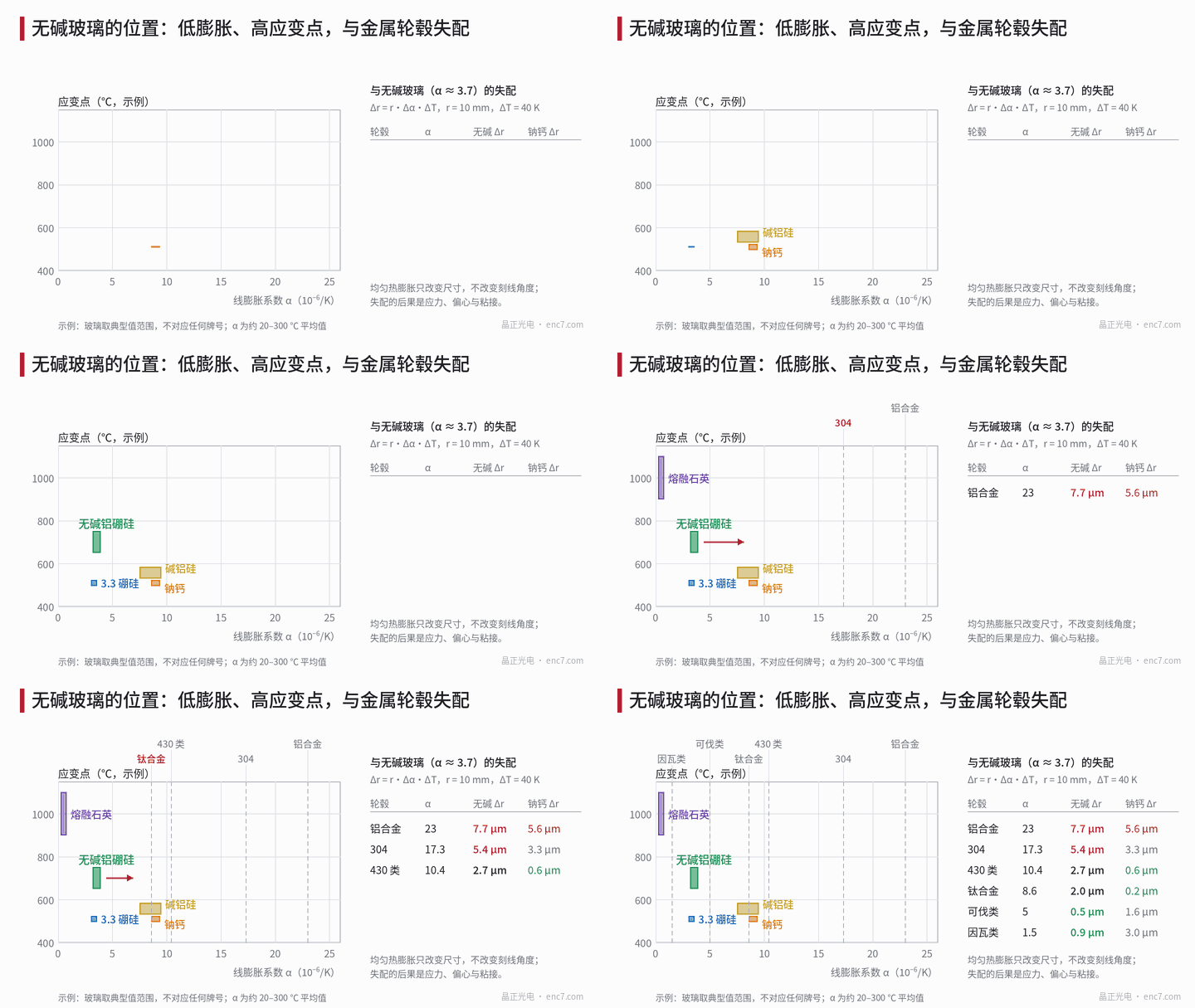
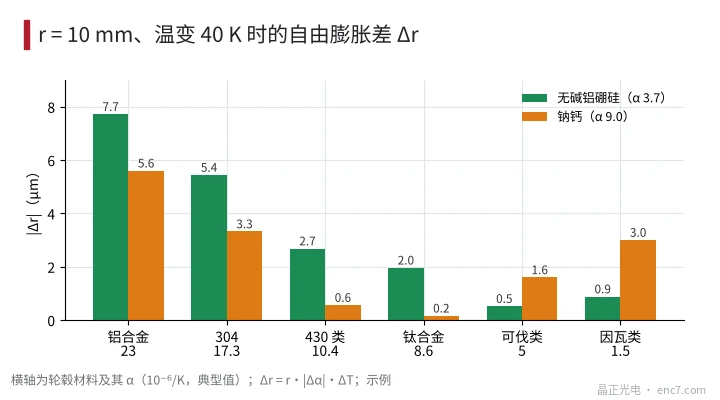
Uniform thermal expansion only changes size, not line angle, so glass–hub CTE mismatch does not directly cause angular error; it causes three other problems: bond and assembly stress, centre shift, and fatigue under temperature cycling. Take glass α = 3.7, bond radius r = 10 mm, temperature swing ΔT = 40 K; the free expansion difference at the radius is Δr = r·Δα·ΔT:
| Hub (α) | Alkali-free Δr | Soda-lime Δr |
|---|---|---|
| Aluminium alloy (23) | 7.7 μm | 5.6 μm |
| 304 stainless (17.3) | 5.4 μm | 3.3 μm |
| 430-class stainless (10.4) | 2.7 μm | 0.6 μm |
| Titanium alloy (8.6) | 2.0 μm | 0.2 μm |
| Kovar-class (5) | 0.5 μm | 1.6 μm |
| Invar-class (1.5) | 0.9 μm | 3.0 μm |
Switching the glass to alkali-free also switches the matching hubs: soda-lime fits 430-class stainless and titanium alloy; alkali-free fits Kovar-class, titanium alloy and Invar-class; aluminium alloy and 304 match neither glass and are worse with alkali-free (Figure 2).
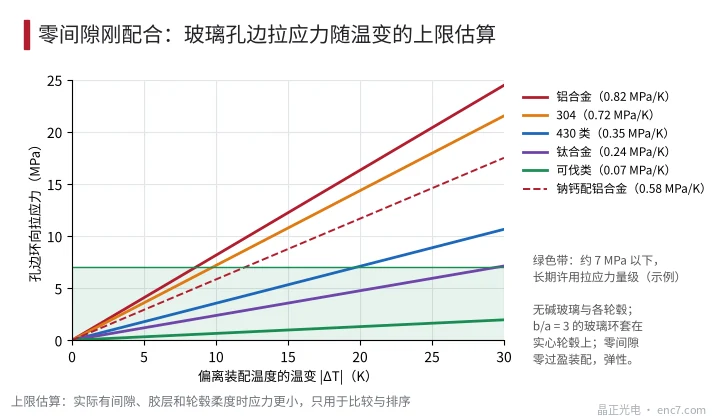
Upper bound for zero-clearance rigid fit. If a glass hole fits a solid hub with no clearance and no adhesive, temperature change puts hoop tension at the hole edge. Treating a glass ring (outer-to-inner diameter ratio 3) and a solid hub elastically, alkali-free glass with aluminium alloy is about 0.82 MPa/K, with 304 about 0.72 MPa/K, with 430-class about 0.35 MPa/K, with Kovar-class about 0.07 MPa/K. Taking a long-term allowable tensile stress of about 7 MPa (order of magnitude, with safety factor, depending on edge quality), aluminium alloy reaches the limit after only about 8.6 K away from assembly temperature (Figure 3). This is an upper bound: real clearance, adhesive and hub compliance lower the stress; use it only for ranking.
Shear in the bond. Adhesive thickness 50 μm, Δr = 7.7 μm (aluminium with alkali-free), shear strain about 0.15. Soft adhesive (shear modulus about 0.5 MPa) gives about 0.08 MPa shear stress – tolerable; hard epoxy (order about 1 GPa) in a full-ring bond calculates far above its strength, so hard adhesive must not be used as a full ring – use soft adhesive, spot bonds or a flexible structure.
Suitable encoder-disc types
Suitable: transmission encoder discs of glass diameter within a few tens of millimetres, assembled with soft adhesive or small-area bonds; discs with high-temperature steps or damp-heat duty; hubs of Kovar-class, titanium alloy or 430-class. Use with care: structures that must hard-connect over a large area to aluminium alloy; discs that need ion-exchange strengthening (alkali-free glass has no exchangeable alkali ions and generally cannot use that route); discs thicker than about 1 mm (incoming stock is usually thin; confirm thick supply).
Engineering notes
- Choose alkali-free glass for low expansion, high strain point and no sodium – not because “it is better”; calculate for the disc’s temperature range, hub and assembly method.
- First check hub α and assembly temperature range, then estimate Δr = r·Δα·ΔT; structures with Δr of several μm need soft adhesive, spot bonds or a flexible structure.
- Do not hard-fit glass to aluminium alloy with zero clearance: about 9 K of temperature change can already put hole-edge tension at about 7 MPa order.
- Switching the hub to Kovar-class, titanium alloy or 430-class usually brings Δr below 2–3 μm.
- Alkali-free glass cannot be ion-exchange strengthened; strength depends on edge and surface quality – put chamfer and post-cut edge quality into the specification.
- Prefer alkali-free for high-temperature steps (bake, cure, coating) to cut shrinkage, but still check the supplier’s strain point and measured data.
Summary
Alkali-free aluminoborosilicate glass has α about 3–4×10⁻⁶/K, strain point 650–750 ℃, and almost no sodium – favourable for chrome thermal stress, high-temperature shrinkage and damp-heat haze. The cost is a larger mismatch with aluminium-alloy and stainless hubs: at r = 10 mm and 40 K, Δr can reach 5–8 μm, and hole-edge tension under zero-clearance fit is about 0.7–0.8 MPa/K. Once you choose alkali-free glass, re-select the hub and bonding method together.
Translated from the ENC7 Chinese technical library (article 0569). Read the Chinese original. Need a disc built to your drawing? Request a quote or see our custom encoder discs.
© Langfang Jingzheng Optoelectronic Technology Co., Ltd. All rights reserved. This article was created with AI assistance.