Manufacturing
Chrome Coating: Depositing a Metal Film a Hundred Nanometres Thick on Glass

The black lines on a glass encoder disc are a chrome film about 0.1 μm thick. How is it deposited in vacuum? How does film thickness relate to opacity? Why does the film peel or get pinholes? This article explains chrome coating with one animated figure.
The ring of black lines on a glass encoder disc is actually a chrome film, usually only about 0.1 μm thick – a few hundred times thinner than a human hair. Such a thin layer of metal must block light completely and also “grow” firmly onto the glass, surviving the development, etching and cleaning that follow. How does it get there?

Why it has to be done in vacuum
In ordinary air a chrome atom cannot travel far before it hits an air molecule, its direction is scrambled, and it may react with oxygen first. Once the chamber is pumped down to vacuum there are few gas molecules left, so chrome atoms fly almost in straight lines to the glass and the film is pure and dense. Vacuum also reduces the chance of moisture and impurities getting into the film.
Two methods: sputtering and evaporation
Sputtering: a small amount of argon is admitted into the chamber and a voltage is applied to form a plasma. Positively charged argon ions are drawn to the negatively biased chrome target and knock chrome atoms out one by one; these atoms then land on the glass (see Figure 1). Magnets behind the target confine electrons near the target surface, raising ionisation efficiency and deposition rate – this is magnetron sputtering. Sputtered atoms have relatively high energy, so the film is generally dense with good adhesion, and uniformity over large areas is easy to achieve.
Evaporation: chrome is heated until it evaporates strongly, and atoms fly in straight lines from the source to the substrate. The equipment is relatively simple, but the atoms have low energy, so film density and adhesion depend more on substrate temperature and surface condition.
Film thickness and optical density: how opacity is calculated
Opacity is measured by optical density: OD = −lg T, where T is the transmittance.
| OD | Transmittance |
|---|---|
| 1 | 10% |
| 2 | 1% |
| 3 | 0.1% |
| 4 | 0.01% |
Light decays exponentially in a metal: each equal increment of film thickness multiplies the transmittance by the same factor smaller than 1. So once the film is continuous, OD increases roughly linearly with thickness – this is the relationship shown by the readout on the right of Figure 1.
Insufficient opacity directly lowers signal contrast. Looking only at the disc itself, with the transmittance of the clear slits taken as 1, the modulation is M = (1 − T) ÷ (1 + T): about 0.82 at OD 1, about 0.98 at OD 2 and about 0.998 at OD 3. Thicker is not always better either: the thicker the film, the longer the etch, the more undercut, and the harder line width is to control. So the film thickness should be set in a range that is “sufficient and stable”, and uniform across the whole plate. Some discs also add a chromium oxide layer on top of the chrome to reduce reflection and stray light.
Adhesion: the film must “grow” onto the glass
Chrome bonds rather well to glass, which is why it is also often used as an adhesion layer for other metal films. But the precondition is a clean surface: if an invisible oil film remains on the glass, the chrome merely “covers” the oil film and will lift and peel during later development and etching. Common practice is thorough cleaning before coating, a final ion-bombardment cleaning step after loading into the chamber and, where necessary, substrate heating. Adhesion can be checked with a tape peel test: apply tape, pull it off and see whether any film comes away.
Where pinholes come from
Pinholes are the most common coating defect. They mainly have three sources:
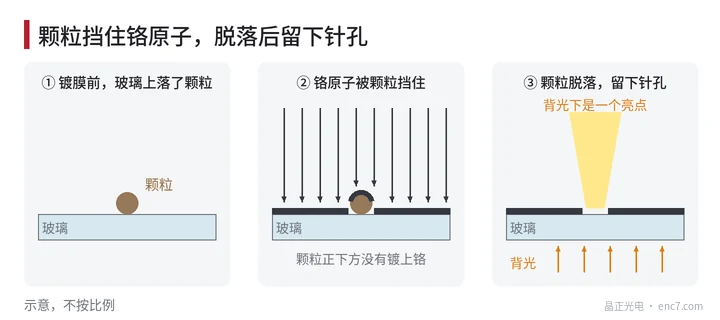
- Particles on the substrate: a particle shadows the chrome atoms so the area beneath it is not coated; when the particle later falls off, a small hole remains (see Figure 2).
- Debris falling inside the chamber: old film built up on chamber walls and shields flakes off and lands on the substrate.
- Local contamination: at oil spots or water marks the film adheres poorly and is lifted off in later wet steps.
The countermeasures correspond one to one: do cleaning and loading in a clean environment, clean the chamber regularly, and inspect under backlight after coating. Under backlight a pinhole is a bright dot; on a line it becomes a light leak.
Summary
Chrome coating lets chrome atoms settle layer by layer onto glass in vacuum. OD rises roughly linearly with film thickness, while transmittance falls by a factor of ten per step. The film must have the right thickness, be uniform, adhere firmly and be free of pinholes – and all of that depends on a clean surface and a clean chamber.
Translated from the ENC7 Chinese technical library (article 0022). Read the Chinese original. Need a disc built to your drawing? Request a quote or see our custom encoder discs.
© Langfang Jingzheng Optoelectronic Technology Co., Ltd. All rights reserved. This article was created with AI assistance.