Manufacturing
Cleaning and Packaging: the Last Two Gates Before Shipment
An encoder disc that has passed inspection still has to be cleaned, dried and packed before it can ship. One fingerprint, one water mark or a little rubbing in transit can undo all the earlier work. This article explains the principles of ultrasonic and ultrapure-water cleaning, how to dry without leaving water marks, how to tell that a disc is really clean, and what packaging and transport must protect against.
From coating to inspection, every step in making an encoder disc is a fight against particles and oil. Before shipment it must pass two more gates: washing off whatever it has picked up during processing, and then “locking in” that cleanliness with packaging until the moment the customer opens the bag for assembly.
What has to be removed
Contamination on a disc surface falls roughly into three types, and the cleaning method must match:
- Particles: glass powder from edge grinding, fibres, dust;
- Organics: resist residue, fingerprints, oil films;
- Ionic residues: salts from etchant, detergent and sweat.
Ultrasonic cleaning: bubbles “knock” the dirt off
Ultrasound in a liquid alternately creates negative and positive pressure, forming a large number of tiny bubbles. When they collapse rapidly they produce local shocks that strip particles and oil from the surface – this is called cavitation. With a suitable detergent it reaches into gaps and edges.
The higher the frequency, the smaller the bubbles and the gentler the action, which suits finer particles; too much power or too long a time can damage film edges or chip the glass edge. So the parameters have to be set according to the disc material and pattern.
Ultrapure-water rinsing: cleaner at every stage
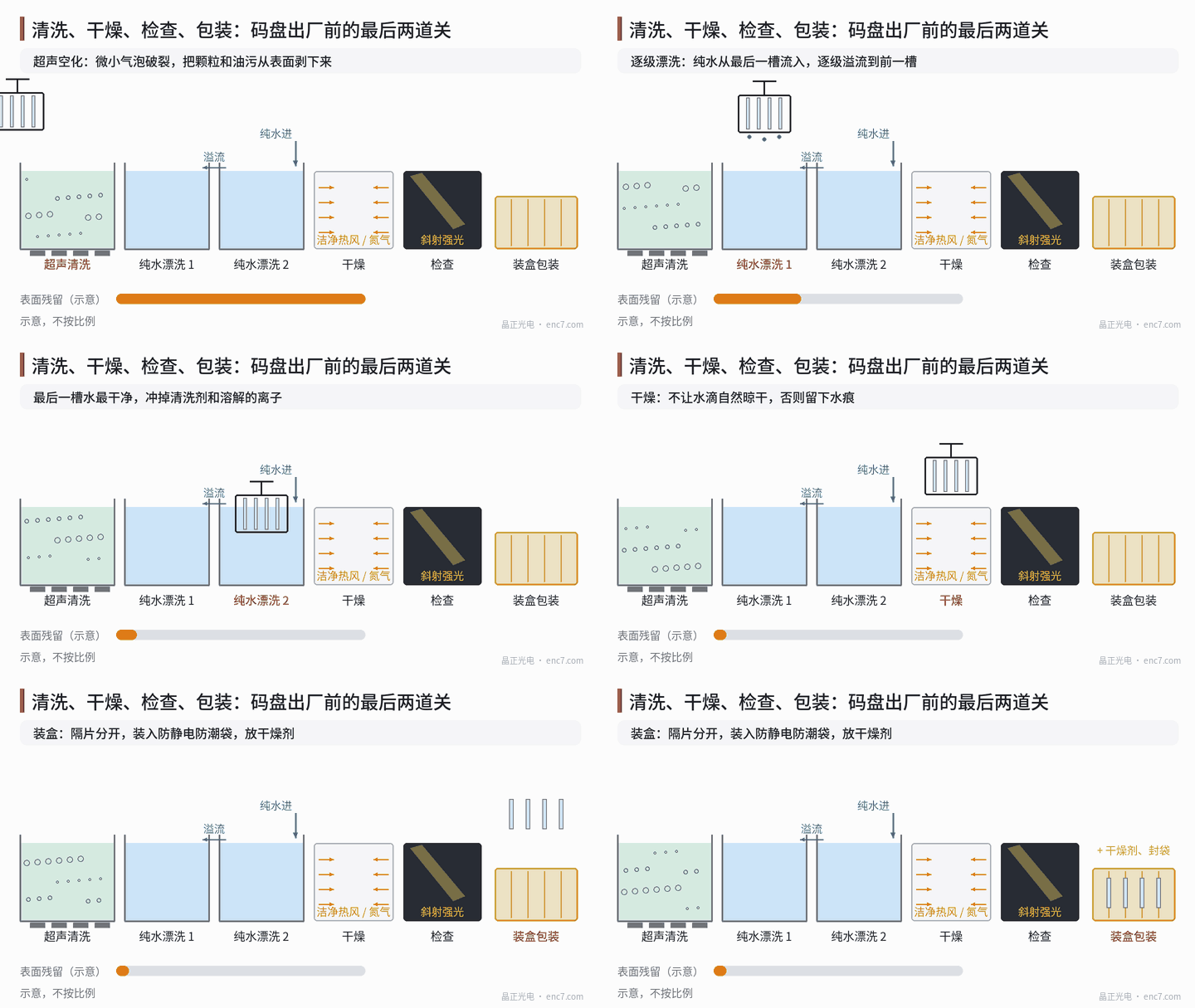
Detergent and the dissolved dirt are flushed away with ultrapure water. A common arrangement is multi-stage rinsing (see Figure 1): clean ultrapure water enters the last tank and overflows stage by stage into the tank before it. The discs move from dirty to clean, so the last water they touch is always the cleanest.
The purity of ultrapure water is usually expressed as resistivity: the fewer ions, the higher the resistivity, with a theoretical limit of about 18.2 MΩ·cm at 25 ℃. Monitoring the resistivity of the rinse water in line reveals a drop in water quality early.
Drying: never let the water dry by itself
When a droplet evaporates naturally, the trace substances dissolved in it stay behind and form a ring-shaped water mark. So a disc must not be left wet; it is blown dry with clean hot air or nitrogen, or slow pull-out or spin drying is used, so that the water leaves the surface before it can leave a mark.
How to tell it is clean
- Inspect the surface under strong oblique light or dark-field illumination – particles, water marks and fingerprints light up;
- Spot-check the pattern area, the edge and the area around the bore under a microscope;
- Do a water-break test on samples: on a clean glass surface water spreads evenly, while the water film breaks up where there is oil;
- If anything abnormal is found, trace back through the cleaning tanks, ultrapure water and operating records.
Packaging: locking the cleanliness in
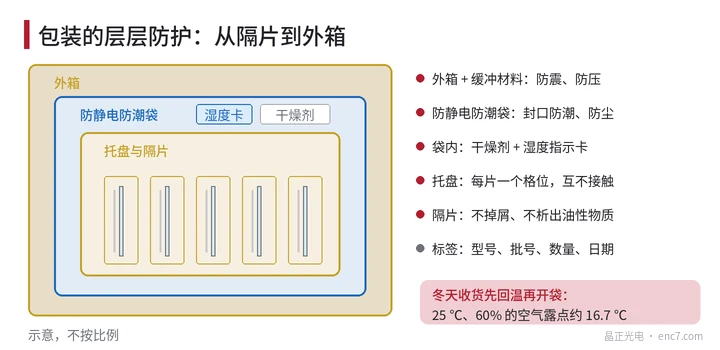
Packaging has to protect against abrasion, dust, static and moisture at the same time (see Figure 2):
- Separation: each disc sits in its own pocket of a tray or is separated by interleaves; discs must not touch each other directly;
- Materials: interleaves and trays must not shed and must not contain plasticisers that can bleed out oily substances, otherwise a haze film forms on the surface;
- ESD protection: static attracts dust onto the disc, so antistatic materials are used;
- Moisture protection: sealed in a moisture-barrier bag with desiccant and a humidity indicator card;
- Labelling: model, lot number, quantity and date, for traceability.
Transport and receiving
The outer carton needs enough cushioning against drops and crushing. When receiving goods in winter, condensation must also be prevented: air at 25 ℃ and 60% relative humidity has a dew point of about 16.7 ℃. If a package brought in from the cold outdoors is opened immediately, the disc surface is below the dew point and water vapour condenses on it. The right way is to leave it in the bag and open it only after it has reached room temperature.
Summary
Cleaning relies on ultrasonic removal of dirt, multi-stage ultrapure-water rinsing and fast drying that leaves no water marks; packaging relies on separation, ESD protection, moisture protection and cushioning to keep the disc clean until it reaches the customer. On receipt, letting the package warm up before opening the bag is the last detail that is easily overlooked.
Translated from the ENC7 Chinese technical library (article 0030). Read the Chinese original. Need a disc built to your drawing? Request a quote or see our custom encoder discs.
© Langfang Jingzheng Optoelectronic Technology Co., Ltd. All rights reserved. This article was created with AI assistance.