Manufacturing
Cleanroom: What a Single Dust Particle Means for an Encoder Disc
The lines on an encoder disc are only a few to a few dozen micrometres wide, so a dust particle of a few micrometres can cause a pinhole, residual chrome or a broken line. This article explains how to read cleanliness classes, how particles compare in size with the lines, what defect a particle leaves depending on the process step where it lands, and how a cleanroom keeps particles under control.
When sunlight slants into a room through a window, you can see many bright specks floating in the air – and those are only the larger dust particles. Smaller particles are invisible to the eye, yet they settle on surfaces just the same. For an encoder disc whose lines are only a few micrometres wide, a single particle of a few micrometres can become a defect.
How to read cleanliness classes
Cleanliness counts the number of particles in the air, not their weight. The “class one hundred” or “class one thousand” still commonly quoted in industry come from US Federal Standard 209E: Class N means no more than N particles ≥0.5 μm per cubic foot of air. That standard has been superseded by ISO 14644-1; the two correspond roughly as follows:
| Common name | ISO class | Limit for particles ≥0.5 μm (per cubic metre) |
|---|---|---|
| Class 10 | ISO 4 | 352 |
| Class 100 | ISO 5 | 3520 |
| Class 1000 | ISO 6 | 35200 |
| Class 10000 | ISO 7 | 352000 |
1 cubic foot is about 0.0283 cubic metres, so 100 particles per cubic foot equals about 3500 per cubic metre, which matches the ISO 5 limit. Each step in class changes the permitted particle count by a factor of 10.
Particles and lines side by side
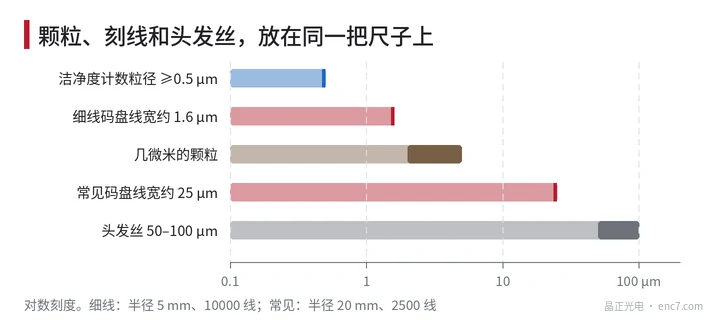
See Figure 2. A human hair is about 50–100 μm in diameter. On a disc with radius 20 mm and 2500 lines, line and clear slit are each about 25 μm wide; on a disc with radius 5 mm and 10000 lines the line width is only about 1.6 μm. A 5 μm particle is a small black dot in a slit of the former, but on the latter it may block several slits at once.
Where the particle lands decides what the defect looks like
The defect a particle causes depends on the process step at which it lands:
| When it lands | Result |
|---|---|
| On the glass before chrome coating | Shadows the chrome atoms; once it falls off, a pinhole remains |
| On the substrate during resist coating | Drags a comet-shaped streak in the resist film; locally uneven thickness |
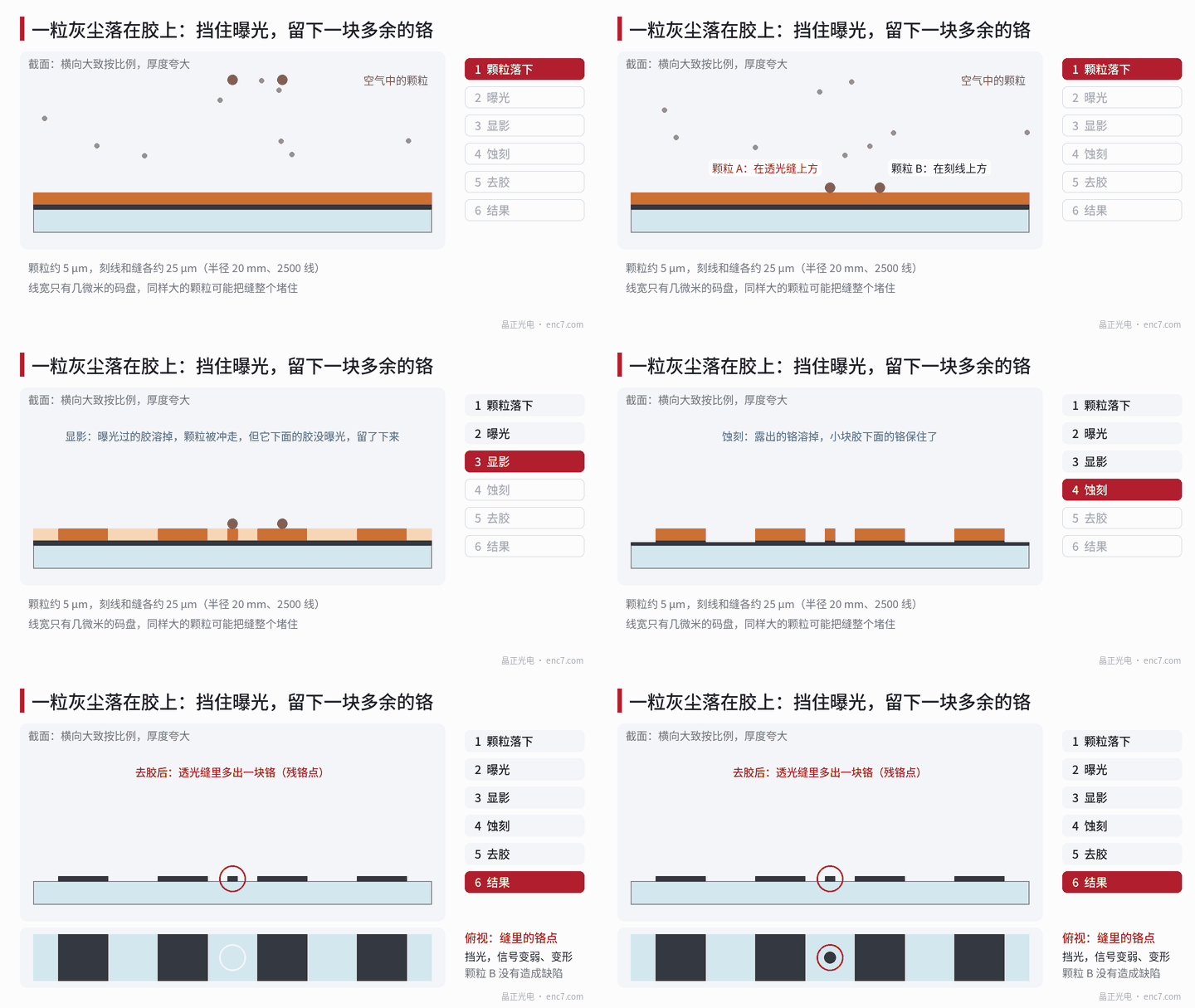
| On the resist in a clear area before exposure | Blocks the UV light; a residual-chrome spot is left in the slit (Figure 1) |
| On the photomask | The same defect appears at the same position on every disc |
| On the finished surface | The stain blocks light; the signal weakens locally |
Figure 1 also shows an interesting detail: with positive resist, a particle that lands on an area where chrome is supposed to remain causes no defect at the exposure step; the dangerous one is the particle that lands in a clear area.
Where particles come from
- People: skin flakes, hair, clothing fibres, exhaled droplets – people are usually the largest particle source in a cleanroom;
- Equipment: wear and friction of moving parts;
- Materials: cardboard boxes, paper, ordinary plastic bags, and glass dust from cutting and edge grinding;
- Process materials: resist, developer, ultrapure water and gases that have not been filtered clean.
How particles are controlled
- Air supply: air is supplied from top to bottom through HEPA filters, forming laminar flow that pushes particles down to the floor and carries them away; the room is kept at positive pressure so outside air cannot enter.
- Zoning: critical stations such as resist coating and exposure can be built as local zones of a higher cleanliness class.
- People: cleanroom garments, gloves and face masks, entry through an air shower, and as little walking around as possible.
- Materials: no cardboard boxes in the clean zone, items wiped before they go in; dust-generating steps such as cutting and edge grinding are separated from the photolithography area.
- Monitoring: regular measurement with a particle counter and trend records; defect inspection after each process step, with root-cause tracing when something abnormal appears.
Summary
A cleanliness class counts how many particles ≥0.5 μm there are. For discs with line widths from a few to a few dozen micrometres, a particle of a few micrometres can cause a pinhole, residual chrome or a broken line, and one on the photomask repeats on every disc. A cleanroom keeps such defects at a very low level through filtered air supply, zoning, people and material management, and continuous monitoring.
Translated from the ENC7 Chinese technical library (article 0029). Read the Chinese original. Need a disc built to your drawing? Request a quote or see our custom encoder discs.
© Langfang Jingzheng Optoelectronic Technology Co., Ltd. All rights reserved. This article was created with AI assistance.