Quality
Common Encoder Disc Defects: Pinholes, Scratches, Residual Chrome and Broken Lines
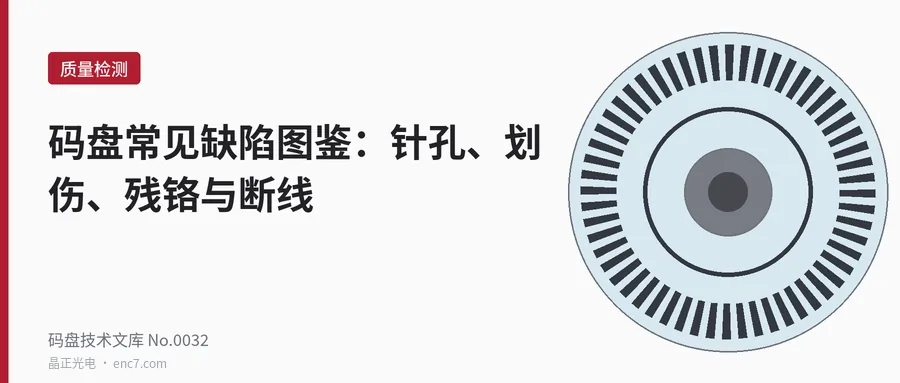
Put a disc under a microscope and you may occasionally see a bright spot on a black line, a dark spot in a bright gap, a long thin bright mark, or a broken line. This article introduces four common defects — pinholes, scratches, residual chrome and broken lines — their appearance, causes and effect on the signal, and explains which dimensions to look at when judging them.
Under a microscope, most of a glass disc is neat black-and-white stripes. Occasionally a few things look “different”: a bright spot in a black line, a dark spot in a bright gap, a long thin bright mark crossing several lines at an angle, or a line with a section missing.
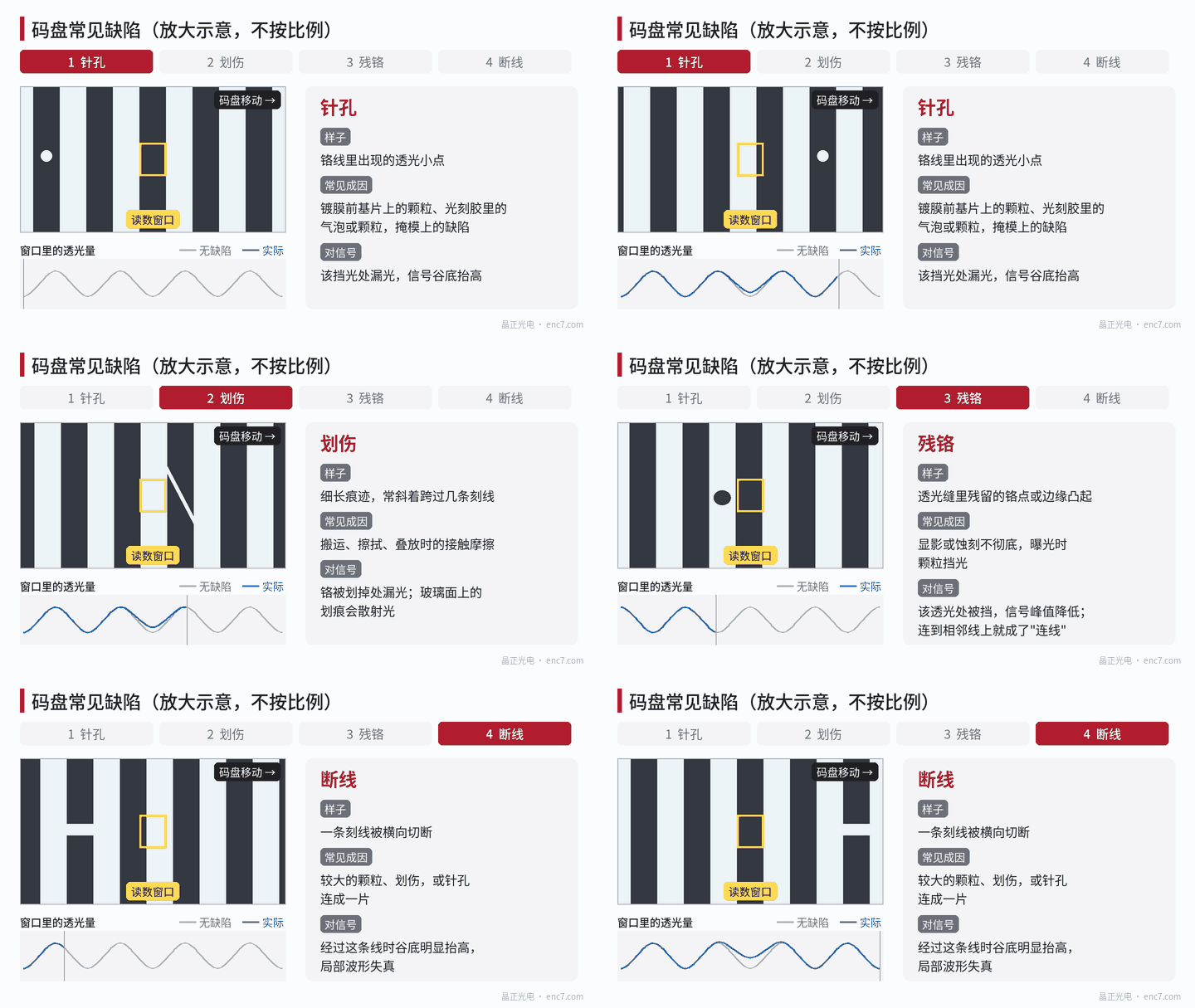
These are the common disc defects. They have different origins and different effects on the signal (Figure 1).
First distinguish “should be dark” from “should be bright”
Taking a transmissive glass disc as the example: chrome lines block light and are dark; glass gaps transmit and are bright. All defects fall roughly into two types:
- Bright where it should be dark: a piece of chrome is missing — pinholes, scratches in the chrome, broken lines. The result is light leakage, raising the signal trough.
- Dark where it should be bright: something extra in the gap — residual chrome, particles, dirt. The result is blocked light, lowering the signal peak.
Reflective metal discs work the same way, with “bright” meaning the reflective area and “dark” the non-reflective area.
Pinholes and broken lines: chrome missing
A pinhole is a small hole in the chrome. Three common sources: a particle on the substrate before coating that falls off afterwards, leaving a spot with no chrome; a bubble or particle in the photoresist through which etchant penetrates and removes chrome that should remain; or a defect in the mask itself, copied onto every disc and showing at the same position on each one.
A broken line is a line cut across, often caused by a large particle, a scratch across lines, or a cluster of pinholes. It is missing the most chrome, and when the reading window passes, the trough rises most noticeably.
Scratches: mostly from contact
Scratches mostly come from handling, stacking, picking up with tweezers, or wiping with a cloth carrying particles. A scratch in the chrome removes it and shows as a bright line, often crossing several lines at an angle; a scratch on the glass face scatters light and is especially visible under oblique illumination. Assembly after shipment can also cause scratches, so discs must be handled properly too.
Residual chrome: extra chrome in the gap
Residual chrome is chrome that should have been etched away but was not fully removed, showing as chrome dots in gaps or bumps on line edges. With the commonly used positive photoresist, the resist over the transmitting gaps is first removed by exposure and development, then the chrome beneath is etched; if a particle blocks light during exposure, or development or etching is insufficient, chrome remains. Severe residual chrome can join two adjacent lines, called “bridging”.
Judge by three things: size, position, count
Size must be judged together with line width. At read radius 20 mm and 2,500 lines, line width is about 25 μm; at radius 5 mm and 5,000 lines the pitch is only 6.3 μm and line width about 3 μm. The same 5 μm pinhole is a small dot on a line of the former but already wider than the line on the latter.
Position decides how strict to be. The incremental track’s reading window covers many lines at once, so a single small defect is averaged out; the reading windows on index and absolute tracks are small and involve fewer lines, so the same defect matters more — on an absolute track it may even cause a bit to be misread. Outside the tracks, in the adhesive area near the bore, requirements can be relaxed.
Count and distribution matter too. One isolated small pinhole and a dense cluster of pinholes mean entirely different things.
Exactly how large and how many are allowed should be agreed by both parties on the drawing or in a defect specification, backed by limit samples. The inspection conditions should also be written down, e.g. magnification and illumination. The same defect can look completely different under another magnification and illumination.
Summary
Pinholes, broken lines and scratches in the chrome are “missing chrome” and raise the signal trough; residual chrome is “extra chrome” and lowers the peak. When judging, consider defect size together with line width, treat functional and non-functional zones separately, and agree inspection conditions in advance so both parties reach the same conclusion.
Translated from the ENC7 Chinese technical library (article 0032). Read the Chinese original. Need a disc built to your drawing? Request a quote or see our custom encoder discs.
© Langfang Jingzheng Optoelectronic Technology Co., Ltd. All rights reserved. This article was created with AI assistance.