Manufacturing
Development and Etching: How the Lines “Grow” onto the Disc
After exposure the pattern is still only a hard-to-see “latent image” in the photoresist. Development turns it into a resist pattern, etching turns that into a chrome pattern, and only after resist strip do the lines truly appear. This article explains the three steps, with emphasis on how undercut, under-etching and over-etching affect line width.
When you take the substrate out after exposure, almost no pattern is visible on the resist surface. Exposed and unexposed resist differ in chemistry – that is the “latent image”. Three steps must follow in sequence: development, etching and resist strip, before the lines can be said to have truly “grown”.
Development: turning the latent image into a resist pattern
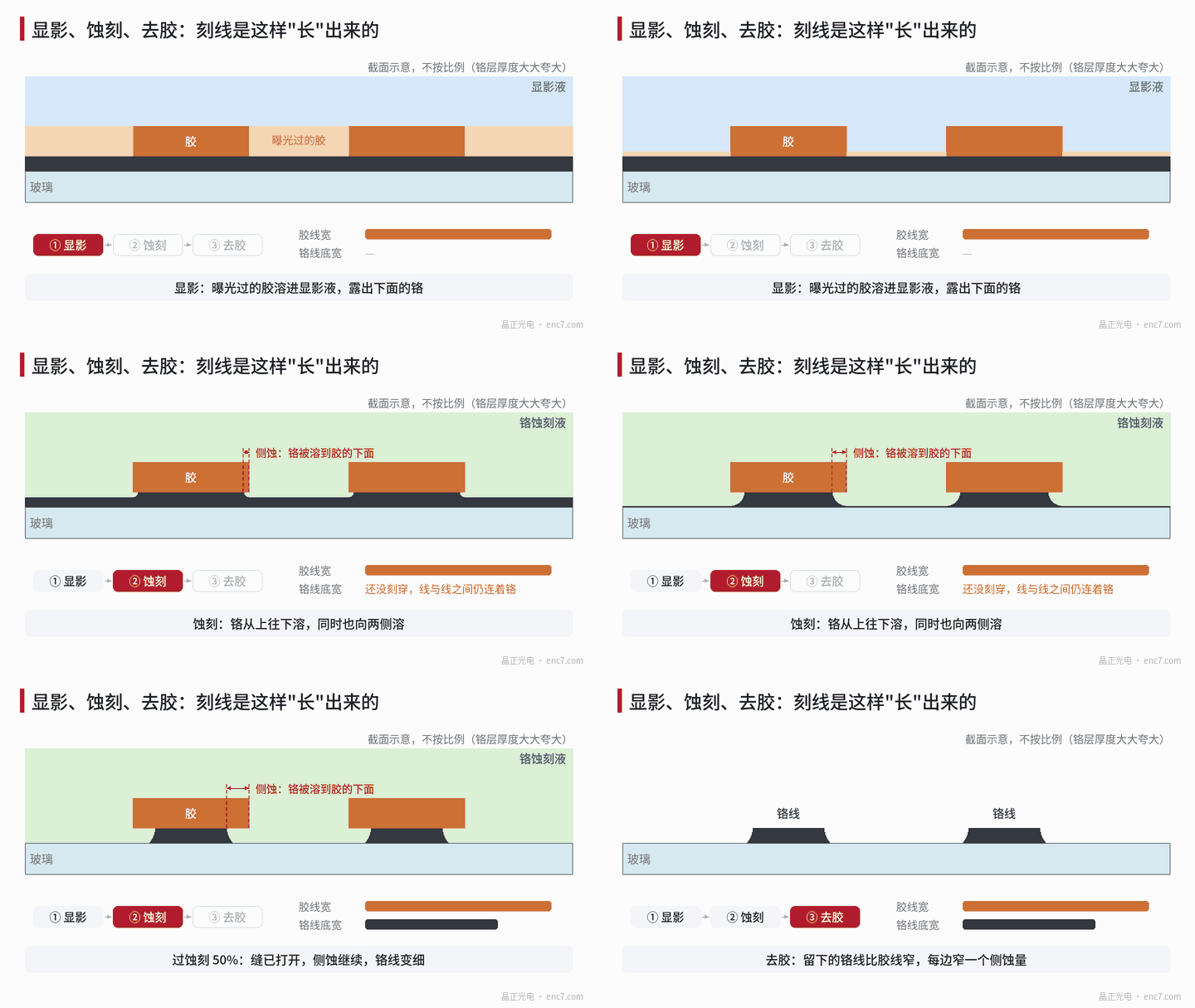
With the commonly used positive resist, exposed areas dissolve quickly in alkaline developer, while unexposed areas dissolve very slowly. After a period of immersion or spray, the resist in the exposed regions is gone, the chrome underneath is uncovered, and a water rinse stops development – see the first step of Figure 1.
Development must control time, temperature and concentration:
- Under-development: a thin layer of resist remains at the bottom of the opening; the chrome beneath cannot be etched away, leaving residual chrome.
- Over-development: some of the unexposed resist is also dissolved, the resist-line edge retreats and the opening widens.
After development the plate is normally inspected once. Problems found at this stage can still be fixed by stripping and recoating and re-exposing; once the chrome has been etched there is no way back. Many processes also bake again before etching to make the resist more etch-resistant.
Etching: dissolving the exposed chrome
Wet etching of chrome commonly uses an etchant based on ceric ammonium nitrate. It dissolves chrome without attacking the glass and barely attacks the resist. When the chrome in a slit is fully dissolved the clear area goes from dark to transparent, which can be used to judge the end point.
Wet etching has one unavoidable trait: it is isotropic – as much is dissolved sideways as downwards. Chrome is dissolved progressively under the resist; that is undercut (see the second step of Figure 1).
Undercut and line-width control
After resist strip, chrome line width is roughly:
chrome line width ≈ resist line width − 2 × undercut
The chrome film is only about 0.1 μm thick, and the undercut is of the same order. To make sure every opening is etched clean, a little over-etching is usually added in practice, which increases undercut further. Assuming 0.15 μm undercut per side, the chrome line is about 0.3 μm narrower than the resist line:
| Designed line width | 0.3 μm narrowing as a share of line width |
|---|---|
| 25 μm (radius 20 mm, 2500 lines) | about 1.2% |
| 3.1 μm (radius 10 mm, 10000 lines) | about 10% |
So the same undercut barely matters on a coarse line and is obvious on a fine one. Common countermeasures are: draw the lines slightly wider on the mask as compensation; keep chrome thickness and etch time stable; for still finer patterns, plasma dry etching can be used to reduce undercut.
Under-etching and over-etching
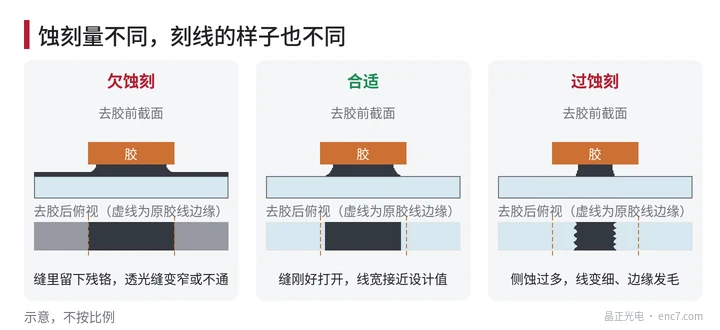
See Figure 2.
- Under-etching: a thin chrome layer remains in the slit; the clear slit becomes narrower or even closed, signal amplitude drops and the duty cycle also drifts.
- Over-etching: undercut is excessive, chrome lines become thinner and edges rough; in severe cases fine lines are undercut from below and break (broken lines).
Etch rate depends on temperature, concentration, agitation and how many times the bath has been used, so production must monitor bath condition and correct time from first-piece line-width measurements. Uneven chrome thickness across a plate can also leave some regions under-etched and others over-etched.
Resist strip: leaving the chrome lines fully exposed
After etching, the remaining resist is removed with stripper or oxygen plasma. Residual resist traps particles, affects later cleaning and bonding, and can make local transmission uneven. Once stripped, the substrate has a complete set of chrome lines and can be measured for line width and inspected for defects.
Summary
Development turns the latent image into a resist pattern; etching turns the resist pattern into a chrome pattern; resist strip leaves the chrome lines exposed. Undercut in wet etching makes the chrome line slightly narrower than the resist line – the finer the line, the larger the effect. Both development and etching have to be “just right”: too little leaves residual chrome; too much thins the lines or breaks them.
Translated from the ENC7 Chinese technical library (article 0025). Read the Chinese original. Need a disc built to your drawing? Request a quote or see our custom encoder discs.
© Langfang Jingzheng Optoelectronic Technology Co., Ltd. All rights reserved. This article was created with AI assistance.