Manufacturing
Edge Grinding and Chamfer: the Disc Edge Decides How Long It Lasts

Glass rarely fails because it is “not hard enough”; most failures start from tiny cracks at the edge. This article uses stress concentration at a crack tip to explain why edge microcracks are dangerous, why they grow slowly, what edge grinding and chamfering do, and how to inspect disc edge quality.
A glass encoder disc leaves the factory with every test passed, yet after some time in an encoder it cracks. Open it up and the crack often starts from the outer circle or the inner-hole edge. Glass itself is not fragile – what is fragile are the invisible microcracks on its edge.
Why glass fails from the edge
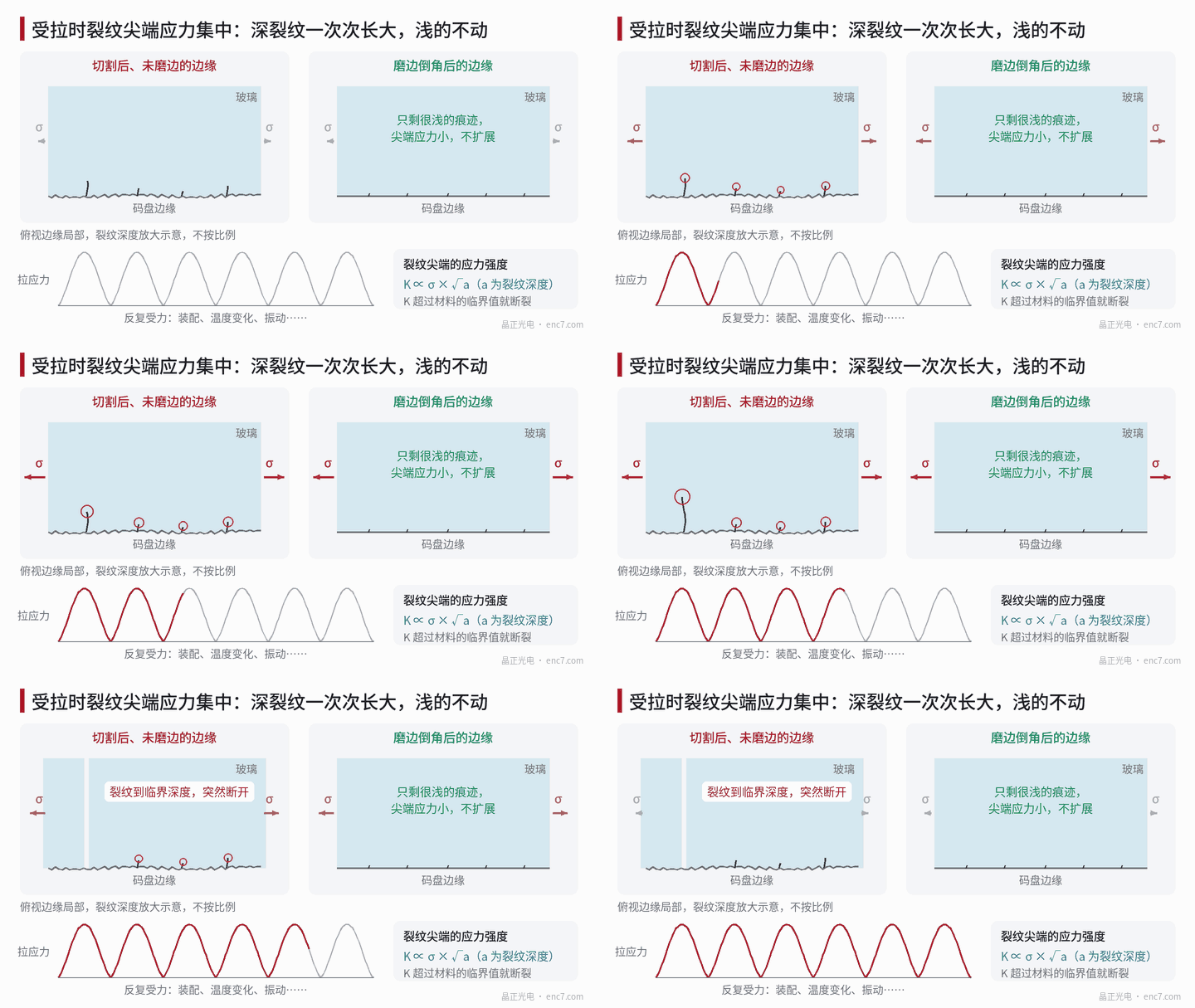
Glass takes compression far better than tension. In tension a fine surface crack acts as an “amplifier”: stress at the tip is much higher than in the surroundings. Fracture mechanics describes this with the stress intensity factor:
K ∝ σ × √a (σ tensile stress, a crack depth)
Once K exceeds the material’s critical value the crack races through the whole plate. From this relation: if crack depth becomes 4 times larger, the tensile stress the glass can bear drops by half.
After cutting, the edge is exactly where cracks are most numerous and deepest: a laser cut has a heat-affected zone; mechanical machining leaves chips and scratches. So the strength of a glass part is largely set by its edge.
Cracks grow slowly
Worse, a crack need not break at once – it can “grow slowly”. While glass is in tension and in contact with moisture in air, stress corrosion at the tip advances it a little at a time. A disc in service is loaded repeatedly: clamping and adhesive shrinkage at assembly, temperature cycles from start-up and shut-down, machine vibration. Each tension cycle lengthens a deep crack a little; the deeper it is the faster it grows, until one cycle reaches critical depth and it snaps (see Figure 1, left).
Shallow cracks have low tip stress, below the growth threshold, and barely move (see Figure 1, right). That is the point of edge grinding: not to make the edge “look nice”, but to remove deep cracks.
What edge grinding and chamfering do
- Edge grinding: a grinding wheel removes the damaged layer from the cut surface; deep microcracks go with it, leaving only shallow, uniform grind marks.
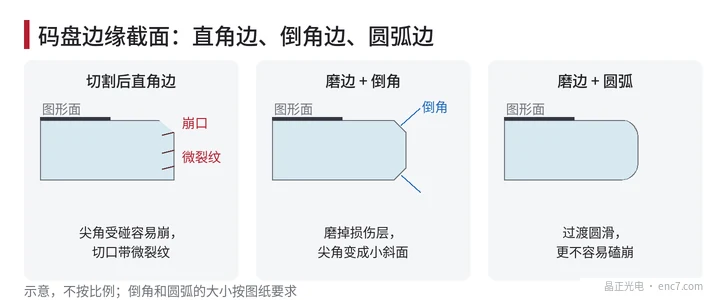
- Chamfer: the sharp right-angle edge is ground into a small bevel or radius (see Figure 2). Sharp corners chip most easily in handling and assembly; chips of glass can scratch the patterned face or fall into the encoder’s optical path.
The inner-hole edge must be treated too, and is often more critical. The disc is bonded to a hub; when temperature changes the two expand differently and stress concentrates at the inner-hole edge. Example: borosilicate glass about 3.3 × 10⁻⁶/K, aluminium alloy about 23 × 10⁻⁶/K; for a 60 K rise at an inner-hole radius of 4 mm the expansion difference is about (23 − 3.3) × 10⁻⁶ × 60 × 4 mm ≈ 4.7 μm. That difference has to be taken by the adhesive and the glass itself – an inner-hole edge with cracks is dangerous.
How to inspect edge quality
Edge inspection can follow this checklist:
- Edge chips: under a microscope scan the outer circle and inner hole once each; record the largest chip’s length along the edge and its inward depth, and compare with the drawing allowance.
- Cracks: with side light or dark-field illumination cracks light up and are easier to see than in bright field.
- Chamfer: whether the width is in the required range, whether it is uniform around the circle, and whether any stretch was missed.
- Residual stress: place the disc between two crossed polarisers; stressed regions show bright fringes, revealing stress from cutting or grinding.
- Cleanliness: powder from grinding must be washed off thoroughly and must not remain on the patterned face.
When buying, it is wise to put allowed chip size, chamfer requirements and inspection method on the drawing so both sides accept to the same “ruler”.
Summary
The strength of a glass encoder disc is set mainly by its edge. Deep cracks grow slowly under repeated tension and eventually cause fracture; edge grinding removes the damaged layer and chamfering removes corners that chip easily. Both outer circle and inner hole must be finished and inspected well if the disc is to survive assembly and long service.
Translated from the ENC7 Chinese technical library (article 0028). Read the Chinese original. Need a disc built to your drawing? Request a quote or see our custom encoder discs.
© Langfang Jingzheng Optoelectronic Technology Co., Ltd. All rights reserved. This article was created with AI assistance.