Glass & substrate science
Glass Baking Shrinkage: Fictive Temperature and Dimensional Change
When glass is baked below its transformation temperature, the fictive temperature relaxes towards the baking temperature and the volume shrinks by amounts of the order of ppm. Using the TNM relaxation model, this article estimates the shrinkage of soda-lime and alkali-free glass between 150 and 600 ℃, shows that uniform shrinkage does not change line angles, and discusses overlay on large plates, temperature non-uniformity and pre-shrinking.
Disc substrates go through several thermal steps – resist baking, coating, adhesive curing – and engineers are often asked whether the glass “shrinks” at these temperatures, and whether a few ppm of shrinkage matters. The answer takes two steps: first estimate the shrinkage at different temperatures, then see which disc specifications that amount actually affects. Glass shrinkage is not thermal expansion and contraction but structural relaxation: glass is a frozen liquid, and during a hold its structure slowly approaches a denser state.
Fictive temperature and the shrinkage model
The structure of a glass can be described by its fictive temperature Tf: the glass is regarded as a liquid that reached equilibrium at Tf and was then frozen. The faster the cooling, the higher Tf and the more open the structure. During a hold at a temperature T < Tf, Tf approaches T over time, and the linear shrinkage is
ΔL/L = (α_l − α_g)·(Tf0 − Tf)
where α_g is the linear expansion coefficient of the glassy state, α_l that of the supercooled liquid, and Tf0 the initial fictive temperature. For α_l − α_g an example value of about 2α_g is taken: about 17×10⁻⁶/K for soda-lime and about 6×10⁻⁶/K for alkali-free aluminoborosilicate glass. The relaxation rate is described by the Tool–Narayanaswamy–Moynihan (TNM) model:
dTf/dt = −(Tf − T)/τ, τ = τ_g·exp[ x·(Δh/R)·(1/T − 1/T_g) + (1−x)·(Δh/R)·(1/Tf − 1/T_g) ]
where Δh/R is the apparent activation temperature, x the non-linearity parameter (taken as 0.5), T_g the reference transformation temperature, and τ_g is set by the cooling rate (taken as 10 K/min). Relaxation is not a single exponential; a stretched exponential with β = 0.6 is used, approximated here by a sum of 44 exponential terms. Example parameters (assumed): soda-lime T_g = 550 ℃, Δh/R = 7×10⁴ K; alkali-free T_g = 735 ℃, Δh/R = 1.0×10⁵ K; the initial Tf0 is taken as the T_g for 10 K/min cooling.
Numerical example: baking temperature and shrinkage
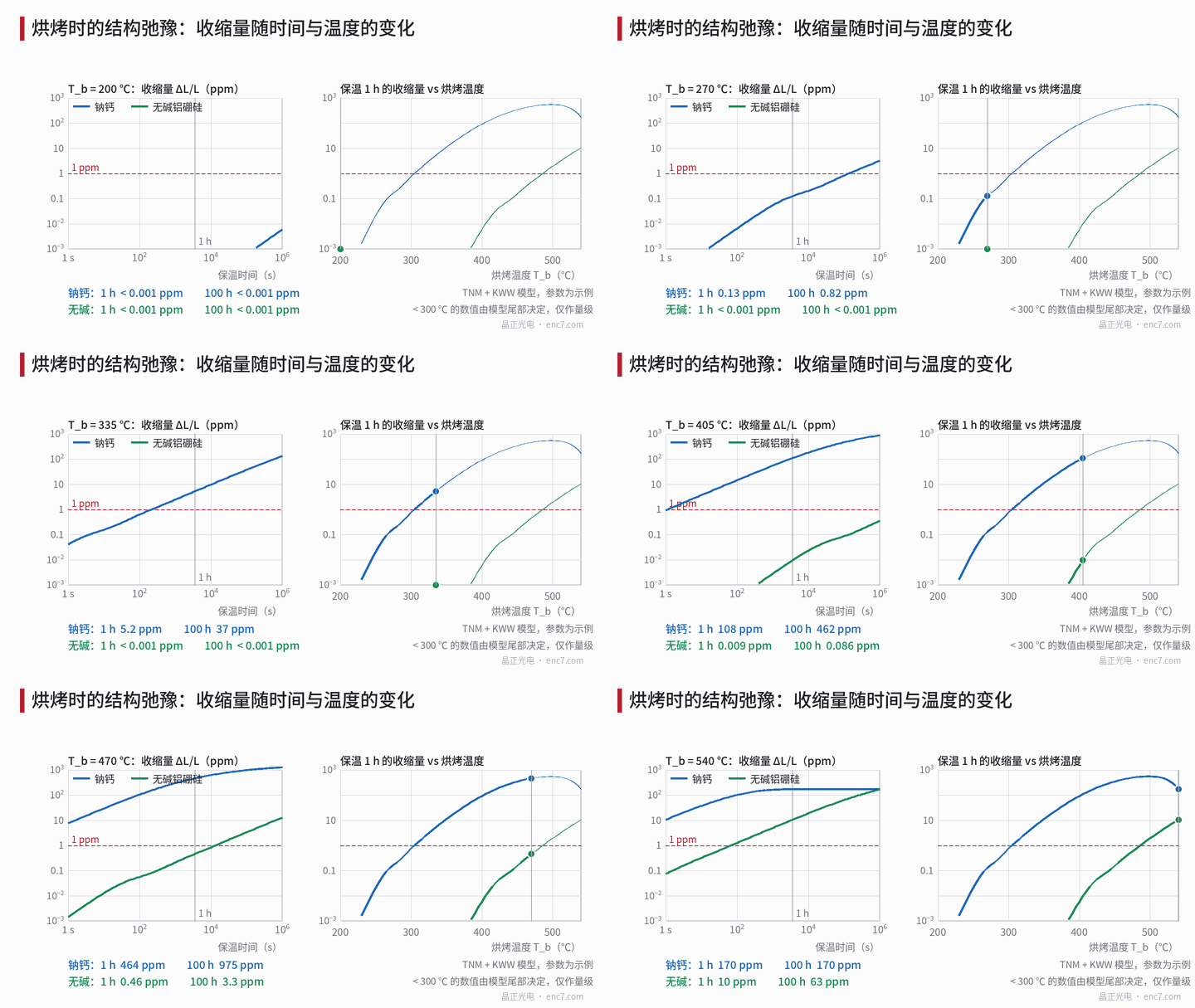
Integrating with the above parameters gives the shrinkage (ppm) after holds of 1 h and 100 h:
| Baking temperature | Soda-lime 1 h | Soda-lime 100 h | Alkali-free 1 h | Alkali-free 100 h |
|---|---|---|---|---|
| 200 ℃ | < 0.001 | 0.002 | ≈ 0 | ≈ 0 |
| 250 ℃ | 0.02 | 0.4 | ≈ 0 | ≈ 0 |
| 300 ℃ | 0.75 | 12 | ≈ 0 | ≈ 0 |
| 350 ℃ | 11 | 150 | < 0.001 | < 0.01 |
| 400 ℃ | 92 | 620 | 0.006 | 0.13 |
| 450 ℃ | 350 | 1100 | 0.16 | 2.5 |
| 500 ℃ | — | — | 1.9 | 28 |
| 550 ℃ | — | — | 15 | 145 |
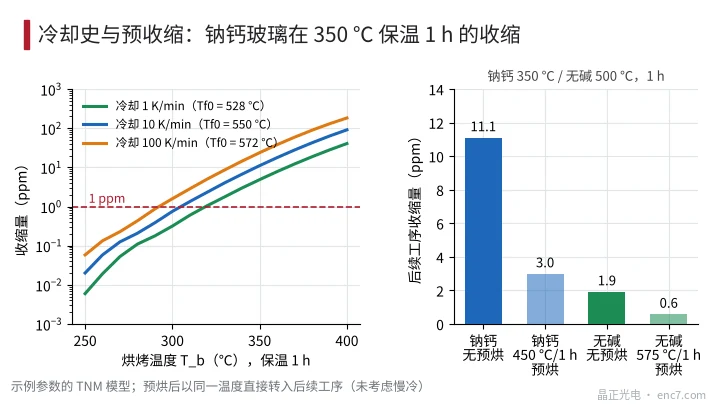
Three conclusions follow. First, shrinkage is extremely sensitive to temperature: for soda-lime glass around 350 ℃, each 1 K increase raises the shrinkage by about 5 %, and between 300 ℃ and 400 ℃ it differs by a factor of about 120. Second, the T_g of alkali-free glass is nearly 200 K higher, so the same shrinkage only appears at a temperature about 200 K higher. Third, the initial cooling history matters: the shrinkage of soda-lime glass at 350 ℃ for 1 h is about 4.9 ppm for an initial cooling rate of 1 K/min, 11 ppm for 10 K/min and 24 ppm for 100 K/min – roughly half for every decade slower.
Values below about 300 ℃ are governed by the early tail of the stretched exponential and are very sensitive to the model form and parameters, so they should be taken only as orders of magnitude: baking soda-lime glass at 150–300 ℃ for 1 h gives about 1 ppm or less, and for alkali-free glass the shrinkage is negligible. The calculated values are no substitute for measurement.
What it means for code discs
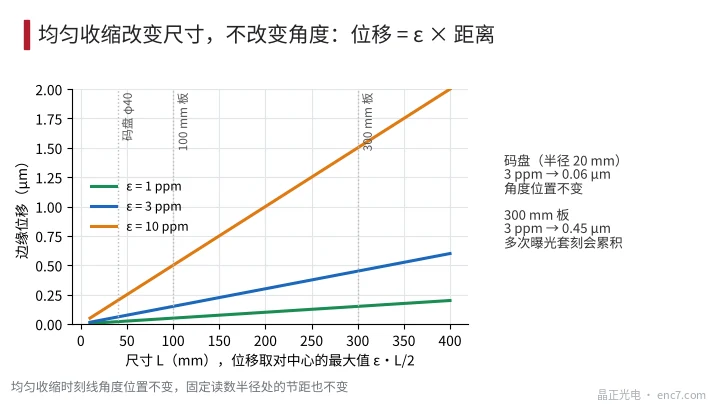
Uniform shrinkage only changes dimensions: the angular positions of the lines do not change, and neither does the pitch at a fixed reading radius (the readhead sees a different circle of lines, whose pitch is still 2πr/N). So there is no direct effect on the angular accuracy of incremental or absolute discs. What changes is the radius: with ε = 3 ppm and r = 20 mm, the track radius changes by 0.06 μm, far less than the radial tolerance of the readhead relative to the track.
Three situations are really affected. First, multi-exposure overlay on large plates: a 300 mm plate shrinking by 3 ppm moves the edge by 0.45 μm relative to the centre, which affects layer-to-layer alignment (Figure 3). Second, temperature non-uniformity: a furnace temperature deviation of ±5 K at 350 ℃ means a shrinkage difference of about ±25 %; an average shrinkage of 11 ppm then brings a non-uniformity of about ±3 ppm across the plate, equivalent to a distortion of the order of 0.4 μm on a 300 mm plate. Third, shrinkage between process steps: if the plate is patterned first and baked afterwards, the pattern scale shrinks relative to the photomask and must be compensated by mask scaling.
Pre-shrinking
To avoid shrinkage in subsequent steps, the substrate can be pre-shrunk: held at a temperature 50–100 K above the highest process temperature, for longer than the process step, and then cooled slowly. With the example parameters, pre-baking soda-lime glass at 450 ℃ for 1 h before a 1 h bake at 350 ℃ reduces the shrinkage from 11 ppm to 3.0 ppm; for alkali-free glass pre-baked at 575 ℃, the shrinkage at 500 ℃ falls from 1.9 to 0.6 ppm. The pre-bake itself causes shrinkage (soda-lime at 450 ℃/1 h about 350 ppm), so it must be done before patterning and cutting; with repeated bakes the shrinkage decreases each time, but the long tail of the stretched exponential means it never reaches zero. Another option is to obtain a lower Tf0 by slower cooling.
Shrinkage should be verified by measuring marks: for two marks 100 mm apart, 1 ppm is only 0.1 μm, whereas soda-lime glass at 9 ppm/K gives 0.09 μm for a temperature deviation of just 0.1 K. The measurement must therefore be temperature-controlled to within ±0.1 K, comparing before and after at the same temperature.
Engineering notes
- Keep thermal steps for soda-lime glass below 300 ℃; shrinkage is then about 1 ppm or less and negligible for code discs.
- Estimate the shrinkage for steps above 350 ℃: each 1 K increase adds about 5 % shrinkage, and the furnace temperature uniformity should be specified accordingly.
- Shrinkage only changes radial dimensions, not angles; for overlay on large plates estimate the displacement as ε·L/2 and then decide whether to scale the photomask.
- If a high-temperature step is needed, pre-bake the substrate 50–100 K above the process temperature before patterning.
- Alkali-free aluminoborosilicate glass shows practically no shrinkage below 400 ℃; prefer it when high-temperature steps are required.
- Verify shrinkage by comparing mark distances under temperature control (±0.1 K); do not simply subtract data taken at room temperature and at high temperature.
Summary
Baking shrinkage of glass comes from relaxation of the fictive temperature and is approximately exponentially sensitive to temperature. With the example parameters, soda-lime glass shrinks by about 1 ppm or less below 300 ℃, rising rapidly from 350 ℃; alkali-free glass shows almost none below 400 ℃. Uniform shrinkage does not change line angles and has little effect on the disc itself, but overlay on large plates, furnace non-uniformity and high-temperature steps must be handled with pre-shrinking and mask compensation.
Translated from the ENC7 Chinese technical library (article 0564). Read the Chinese original. Need a disc built to your drawing? Request a quote or see our custom encoder discs.
© Langfang Jingzheng Optoelectronic Technology Co., Ltd. All rights reserved. This article was created with AI assistance.