Selection
How Fine Are Encoder Disc Lines? From 1,000 to 10,000 Lines

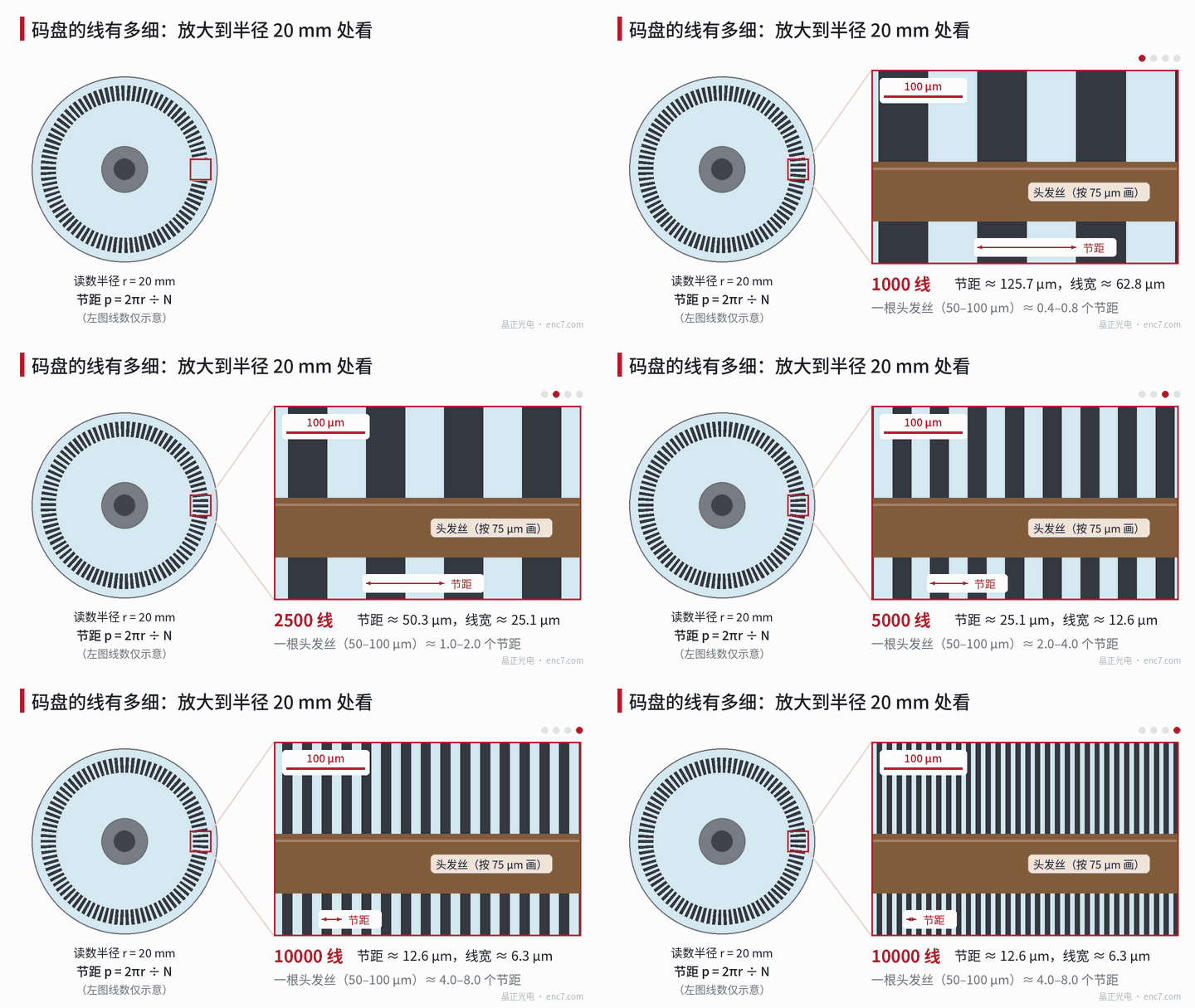
How fine the lines on a disc are is set jointly by line count and radius: pitch p = 2πr ÷ N. At radius 20 mm, 1,000 lines gives a pitch of about 126 μm, while 10,000 lines gives only about 12.6 μm. This article provides a table of common pitches and explains what finer lines require of process and assembly.
When choosing a disc people say “2,500 lines” or “5,000 lines”. Line count is the number of lines in one revolution — but how fine is each line? The answer depends not only on line count but also on the radius at which the lines are placed.
Calculating the pitch
The distance between the centres of adjacent lines is the pitch, and it is simple to calculate:
p = 2πr ÷ N
r is the radius of the lines and N the line count. Example: radius 20 mm, 2,500 lines. The circumference is 2π × 20 mm ≈ 125.66 mm, i.e. about 125,660 μm; divided by 2,500, the pitch is about 50.3 μm. With lines and gaps at 1:1, the line width is about half the pitch, about 25 μm.
A pitch table
Pitch (μm) at common line counts and radii:
| Line count N | r = 5 mm | r = 10 mm | r = 20 mm | r = 40 mm |
|---|---|---|---|---|
| 500 | 62.8 | 125.7 | 251.3 | 502.7 |
| 1000 | 31.4 | 62.8 | 125.7 | 251.3 |
| 2048 | 15.3 | 30.7 | 61.4 | 122.7 |
| 2500 | 12.6 | 25.1 | 50.3 | 100.5 |
| 5000 | 6.3 | 12.6 | 25.1 | 50.3 |
| 10000 | 3.1 | 6.3 | 12.6 | 25.1 |
Two rules: doubling the line count halves the pitch; doubling the radius doubles the pitch. So the same 10,000 lines give about 25 μm pitch at radius 40 mm, but only about 3 μm when squeezed to radius 5 mm.
Compared with a hair
A hair is generally about 50–100 μm in diameter. Using it for comparison (Figure 1):
- Radius 20 mm, 1,000 lines: pitch about 126 μm, wider than a hair;
- Radius 20 mm, 10,000 lines: pitch about 12.6 μm; one hair covers 4–8 periods;
- Radius 10 mm, 10,000 lines: pitch about 6.3 μm, line width only about 3 μm; one hair covers 8–16 periods.
What gets harder as lines get finer
Line-width deviation becomes a larger share. The same 1 μm deviation is only 4% of a 25 μm line but about 33% of a 3 μm line, noticeably changing duty cycle and signal. Exposure, development and etching all need finer control.
Dust is more damaging. A particle of a few microns landing on a fine line can cause a pinhole or a broken line. Fine-pitch discs must be produced in cleaner environments and inspected with higher-resolution image measurement and visual inspection.
The read gap is smaller. Imaging-type reading requires a gap g much smaller than p² ÷ λ. With λ = 0.88 μm: at 50 μm pitch p² ÷ λ is about 2.8 mm; at 20 μm about 455 μm; at 10 μm only about 114 μm. The smaller the pitch, the closer the readhead must be to the disc, and the stricter the requirements on assembly, axial runout and disc flatness.
Choosing line count and radius
To get a high line count without too small a pitch, the most direct approach is to put the lines at a larger radius, at the cost of a larger disc OD. Another route is a moderate line count with sine/cosine interpolation to make up resolution — for example 2,048 lines with 1,024× interpolation gives 2,097,152 counts per revolution (21 bits). The trade-off should be decided considering installation space, readhead and cost together.
Summary
Line fineness is about pitch: p = 2πr ÷ N. Common disc pitches range from over a hundred microns down to a few microns; the finest are a few tens of times thinner than a hair. The finer the lines, the higher the demands on lithography accuracy, cleanliness, inspection and read gap — so choose line count together with radius.
Translated from the ENC7 Chinese technical library (article 0017). Read the Chinese original. Need a disc built to your drawing? Request a quote or see our custom encoder discs.
© Langfang Jingzheng Optoelectronic Technology Co., Ltd. All rights reserved. This article was created with AI assistance.