Introduction to encoder principles
How Singleturn and Multiturn Absolute Encoders Differ

A singleturn absolute encoder assigns a unique code to every position within one revolution; after one turn the code repeats. A multiturn absolute encoder also records how many revolutions have been made, usually either by a gear-train counter or by a battery-backed counter. This article explains the two principles, how position is remembered through a power loss, and where each type is used.
When an industrial robot is powered up again after a power loss, the joints know their positions at once and do not need to home. An incremental encoder cannot do this; it takes an absolute encoder, and usually a multiturn one.
What is the difference between singleturn and multiturn? In one sentence: singleturn knows “which angle it has reached”; multiturn also knows “how many revolutions it has made”.
Singleturn absolute: every position within one revolution has its own code
A singleturn absolute disc has several concentric tracks. The readhead reads the light and dark of every track at once along a radius, forming a binary number. n tracks can distinguish 2ⁿ positions. The main disc in Figure 1 has only 4 bits, so one revolution is divided into 16 steps; real products have far more bits:
| Singleturn bits | Positions per revolution | About, per position |
|---|---|---|
| 12 bits | 4096 | 316″ |
| 17 bits | 131 072 | 9.9″ |
| 20 bits | 1 048 576 | 1.24″ |
The tracks generally use Gray code, so adjacent positions differ in only one bit and misreads are avoided.
The limitation of a singleturn absolute encoder is equally clear: after 360°, the code starts again from the beginning. When a motor drives a load through a gearbox or a leadscrew, the full travel often takes many revolutions, and knowing the angle alone is not enough.
Multiturn method one: gear-train turn counting
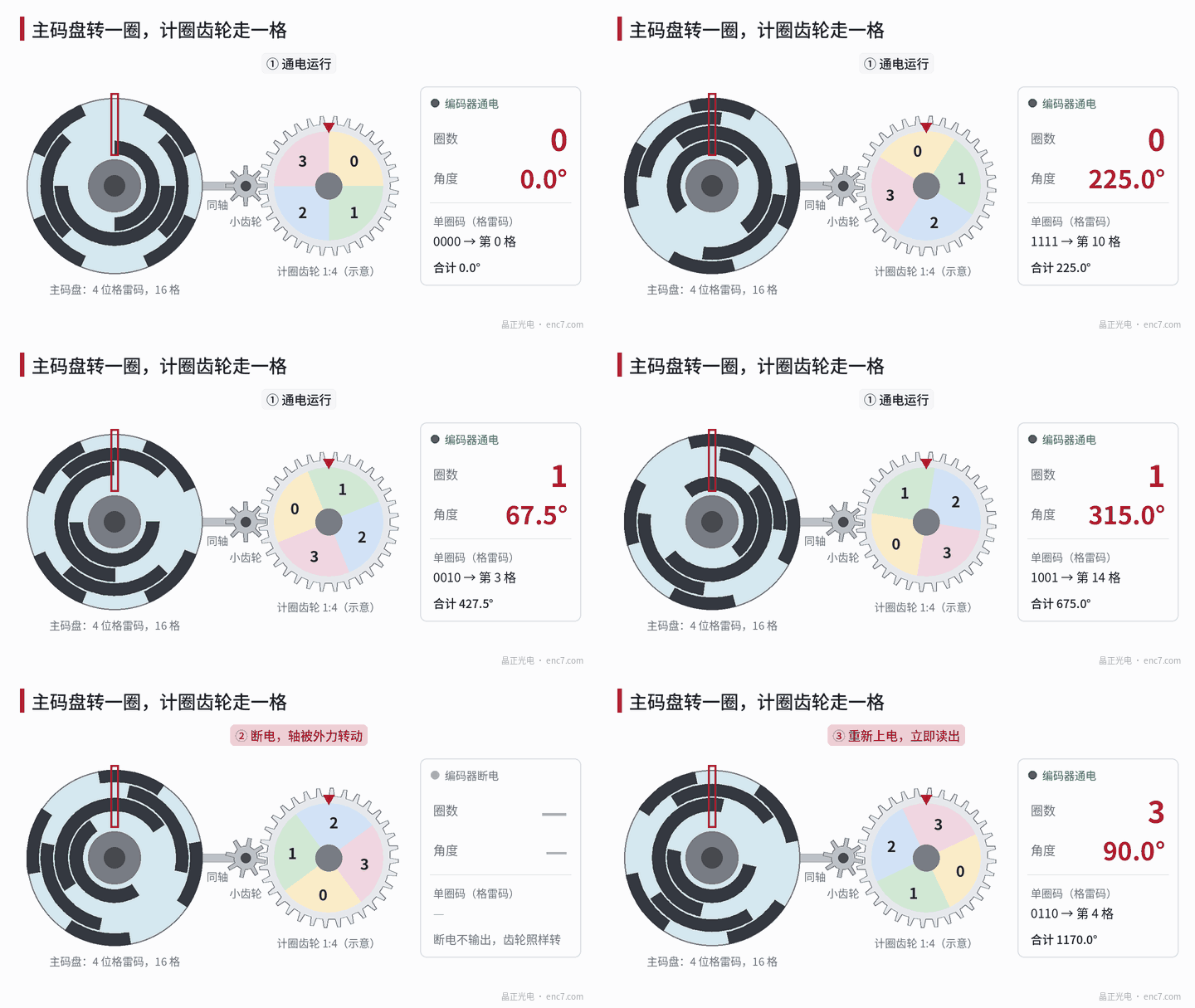
A small gear on the main shaft drives one or more reduction stages, and each stage carries a small turn-counting disc. Each revolution of the main shaft advances the first-stage turn-counting disc by one step; see Figure 1.
Several stages in series can count a number of revolutions equal to the product of the steps of each stage. An example: 3 stages of 16 steps each can distinguish 16 × 16 × 16 = 4096 revolutions.
The advantage of gear-train turn counting is “mechanical memory”: if the shaft is turned while power is off, the gears still turn with it, and the position can be read as soon as power is applied — no battery is needed. To avoid a misread at the instant the turn-counting disc changes step, the circuit uses the angle of the main disc to correct the turn count. The cost is more parts and a relatively larger structure and volume.
Multiturn method two: battery plus a counter
The other method uses no gears: an electronic circuit counts the turns. Each time the main disc passes the index, the counter increments by 1 or decrements by 1. After the main supply is removed, a battery powers the turn-counting circuit so that it can keep working at low power and still record shaft motion during the outage.
The structure is compact and is common on servo motors. The point to watch is that the battery has a finite life; if it is exhausted or replaced incorrectly, the turn count is lost and the origin must be set again. During maintenance the battery should therefore be checked and replaced on the schedule in the manual.
How the multiturn position is calculated
Multiturn absolute position = number of revolutions × counts per revolution + singleturn count.
For example, with 17 bits singleturn, if the motor has turned 3¼ revolutions from the origin, the reading is 3 × 131 072 + 32 768 = 425 984. If the motor drives a table through a leadscrew with a 10 mm lead, the table has travelled 32.5 mm.
How to choose
| Type | What is known after power-up | Homing required? | Typical use |
|---|---|---|---|
| Incremental | Nothing | Yes | Machines that can home on power-up |
| Singleturn absolute | The angle within one revolution | Not if travel stays within one revolution | Direct-drive rotary tables, oscillating mechanisms |
| Multiturn absolute | Revolutions + angle | No | Robot joints; axes driven through a gearbox or a leadscrew |
In brief
A singleturn absolute encoder uses several tracks to give every position within one revolution its own code; after one revolution the code repeats. A multiturn absolute encoder adds a turn-counting arrangement: gear-train counting relies on mechanical memory and needs no battery; a battery plus a counter is compact, but the battery must be maintained. An axis whose travel exceeds one revolution and that cannot home on power-up should use a multiturn absolute encoder.
Translated from the ENC7 Chinese technical library (article 0007). Read the Chinese original. Need a disc built to your drawing? Request a quote or see our custom encoder discs.
© Langfang Jingzheng Optoelectronic Technology Co., Ltd. All rights reserved. This article was created with AI assistance.