Glass & substrate science
Identifying Glass Types: Density, Refractive Index and UV Checks
Soda-lime, borosilicate, alkali aluminosilicate and quartz glass look almost identical. This article gives a quick identification method using Archimedes density, refractive index and UV observation, calculates the measurement accuracy needed to separate neighbouring types, and explains why soda-lime and alkali aluminosilicate glass must be told apart with the help of the refractive index.
The label on the incoming material says “borosilicate” – is it really, once you cut it open? The four commonly used substrate types are practically indistinguishable by appearance: thick pieces are transparent with a slightly green edge, and after chrome coating of the lines the difference is even harder to see. But their density, refractive index and UV absorption all differ, and a few measurements that can be done on a bench are enough to check the basic type. The difficulty is that the measurement error must be smaller than the spacing between types, and the batch-to-batch distributions of neighbouring types may themselves overlap.
The “fingerprints” of the four types
The table gives typical values (examples, not corresponding to any brand; manufacturers differ):
| Type | Density ρ (g/cm³) | Refractive index n_d | UV absorption edge (order of magnitude) |
|---|---|---|---|
| Fused silica | approx. 2.20 | approx. 1.458 | below 200–250 nm, transmits 254 nm |
| Type 3.3 borosilicate | approx. 2.23 | approx. 1.473 | approx. 280–310 nm, essentially opaque at 254 nm |
| Alkali aluminosilicate | 2.4–2.5 | approx. 1.50–1.51 | approx. 280–340 nm, opaque at 254 nm |
| Soda-lime | approx. 2.50 | approx. 1.52 | approx. 310–340 nm (iron-bearing), opaque at 254 nm |
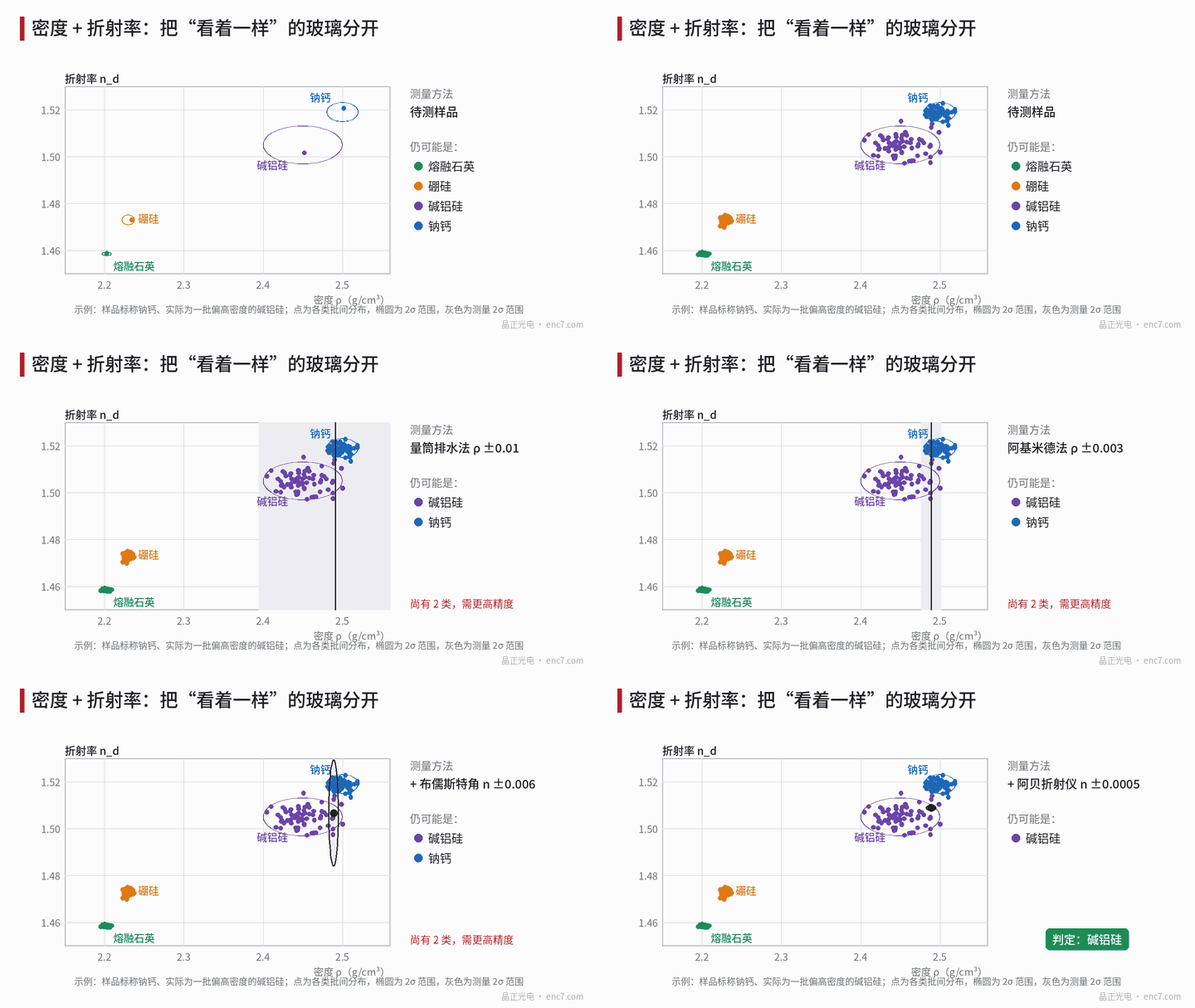
Silica and borosilicate differ by 0.027 in density and 0.0145 in refractive index – a wide spacing. Soda-lime and alkali aluminosilicate overlap in density and differ by 0.014 in refractive index, making them the hardest pair to separate.
Archimedes method: how many digits of density
The specimen is weighed in air (m_a) and immersed in water (m_w); then
ρ = ρ_w·m_a / (m_a − m_w)
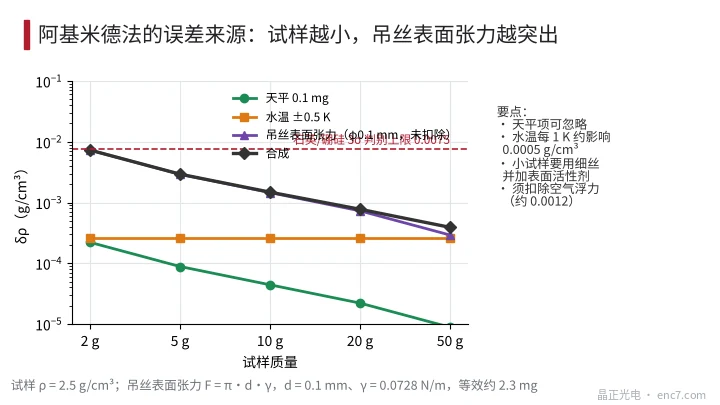
where ρ_w is the density of water (about 0.9982 g/cm³ at 20 ℃, about 0.9971 at 25 ℃), followed by an air-buoyancy correction of about 0.0012 g/cm³. Errors come from three sources: balance reading, water temperature and surface tension on the suspension wire. For a specimen with ρ = 2.5 g/cm³:
- Balance 0.1 mg: a 20 g specimen displaces 8 g of water, a relative error of about 10⁻⁵ – negligible.
- Water temperature ±0.5 K: water density changes by 2.1×10⁻⁴ g/cm³ per K, affecting ρ by about 0.0003 g/cm³.
- Suspension wire: for a φ0.1 mm wire passing through the water surface, the surface-tension force F = π·d·γ ≈ 2.3×10⁻⁵ N, equivalent to about 2.3 mg, with the greatest effect on small specimens.
| Specimen mass | 2 g | 5 g | 10 g | 20 g | 50 g |
|---|---|---|---|---|---|
| δρ (g/cm³) | 0.007 | 0.003 | 0.0015 | 0.0008 | 0.0004 |
The specimen should therefore weigh 10 g or more, or a finer wire with a trace of surfactant should be used, together with temperature-controlled water and removal of bubbles.
Combined identification: how accurate must it be
Let the standard deviations of the batch-to-batch distributions of the two types be σ₁ and σ₂ (example values: silica 0.003 / 0.0003, borosilicate 0.004 / 0.001, alkali aluminosilicate 0.025 / 0.004, soda-lime 0.010 / 0.002; the first is for ρ, the second for n). Requiring the spacing Δ to reach 3 times the combined standard deviation, the largest permissible measurement standard deviation is
σ_m = √[(Δ/3)² − σ₁² − σ₂²]
| Pair of types | Upper limit of σ_m, density | Upper limit of σ_m, refractive index |
|---|---|---|
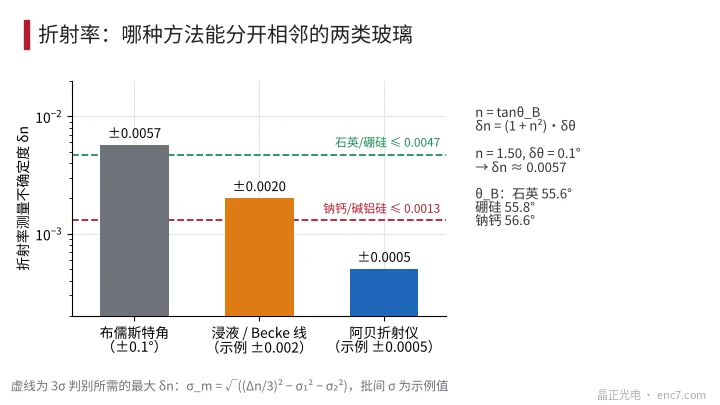
| Silica / borosilicate | 0.0075 g/cm³ | 0.0047 |
| Soda-lime / alkali aluminosilicate | no solution (batch distributions already overlap) | 0.0013 |
Silica and borosilicate can be separated with Archimedes density at ±0.003, and for the refractive index the Brewster-angle method is almost good enough: tanθ_B = n, δn = (1+n²)·δθ; with an angle reading of ±0.1°, δn ≈ 0.0057, slightly above the 0.0047 limit. For soda-lime and alkali aluminosilicate, density alone is not enough: because of the batch-to-batch standard deviations, the z value of the two density distributions is only 1.9. The refractive index must be within ±0.0013; the immersion method (example ±0.002) is not sufficient, only an Abbe refractometer (example ±0.0005) is reliable (Figure 3). The combined z value of the two is about 3.6; the sample in Figure 1 is classified as alkali aluminosilicate only once the refractive index accuracy is within ±0.0005.
UV observation serves as a supplement, not as a quantitative criterion. Under a 254 nm lamp (wear UV-protective goggles), only silica transmits; the other three types do not. The fluorescence colour and intensity of silica vary with the melting method and impurities, so compare with known samples and do not use it as an absolute criterion. The tin side of tin-bearing float glass fluoresces; see the tin-side article in this library.
Incoming check procedure
- Appearance and 254 nm UV: first separate silica from the other three types.
- Archimedes density (specimen ≥ 10 g, water temperature ±0.5 K): distinguish 2.20 and 2.23 from the group at 2.4 and above.
- Refractometer or immersion: separate soda-lime from alkali aluminosilicate; accuracy must be better than ±0.0013.
- If doubt remains, use composition analysis or the expansion coefficient (see the separate article in this library).
Engineering notes
- First ask which pair has to be separated: silica/borosilicate by density plus refractive index; soda-lime/alkali aluminosilicate requires a refractive index within ±0.0013.
- Archimedes specimens should be no lighter than 10 g; use temperature-controlled water, a fine wire with surfactant, and apply the air-buoyancy correction.
- The Brewster-angle method with an angle reading of ±0.1° gives only ±0.0057 in δn – fine for a rough check, not for separating the neighbouring soda-lime and alkali aluminosilicate.
- Report measured values together with their uncertainty and compare them with the supplier’s batch-to-batch distribution, rather than only checking whether they fall on the nominal value.
- Use the UV lamp only as an aid; a 254 nm lamp can damage the eyes, so goggles are mandatory.
- Keep retained samples from every batch and build your own density–refractive index distribution; this is more reliable than quoting handbook values.
Summary
Glass types can be checked by combining density, refractive index and UV absorption. Silica and borosilicate are far apart and can be separated by Archimedes density at ±0.003 g/cm³; soda-lime and alkali aluminosilicate overlap in density, so the refractive index accuracy must be better than ±0.0013. Choosing the method according to this budget is more reliable than going “by feel and by brand”.
Translated from the ENC7 Chinese technical library (article 0566). Read the Chinese original. Need a disc built to your drawing? Request a quote or see our custom encoder discs.
© Langfang Jingzheng Optoelectronic Technology Co., Ltd. All rights reserved. This article was created with AI assistance.