Manufacturing
Laser Cutting: Why Glass Encoder Discs Are Not Cut with a Tool

A glass encoder disc must be cut from the full plate into an outer circle and an inner hole, concentric with the lines. Wheel scribing is good only at straight lines; grinding brings contact force and edge chips. This article covers the basics of laser cutting glass, its advantages in free contour, concentricity and non-contact cutting, and the heat-affected zone and post-processing.
After photolithography the disc pattern is still on one full glass plate. Next it must be cut into individual round discs: an outer circle outside and an inner hole in the middle for the shaft. Window glass can be scored with a cutting wheel – why do encoder discs need a laser?
Where mechanical methods struggle
Glass is hard and brittle; common mechanical routes each have limits:
- Wheel scribing: a shallow score is made on the surface and the glass is broken. Straight lines break well; a closed circle is hard to break, and an inner hole is almost impossible.
- Diamond grinding and trepanning: circles and holes are possible, but the tool presses on the glass; contact force and vibration easily cause edge chips and microcracks; the tool wears and dimensions drift; coolant and swarf can also contaminate the patterned face.
For a disc only a few tens of millimetres across with fine lines on its surface, none of these problems is small.
How a laser cuts glass
Laser cutting of glass relies on depositing energy along a very narrow path. Two common approaches:
- Thermal-stress separation: a long-wavelength laser that glass absorbs strongly (for example a CO₂ laser) heats along the path; local thermal stress makes the glass crack along the intended route.
- Ultrashort-pulse machining: ordinary glass is transparent at many wavelengths, but focusing picosecond or femtosecond pulses inside the glass causes nonlinear absorption at the focus, forming a modified track along the path that is then separated.
Which method and which parameters depend on glass type, thickness and edge requirements.
Advantage one: one setup, cut concentric
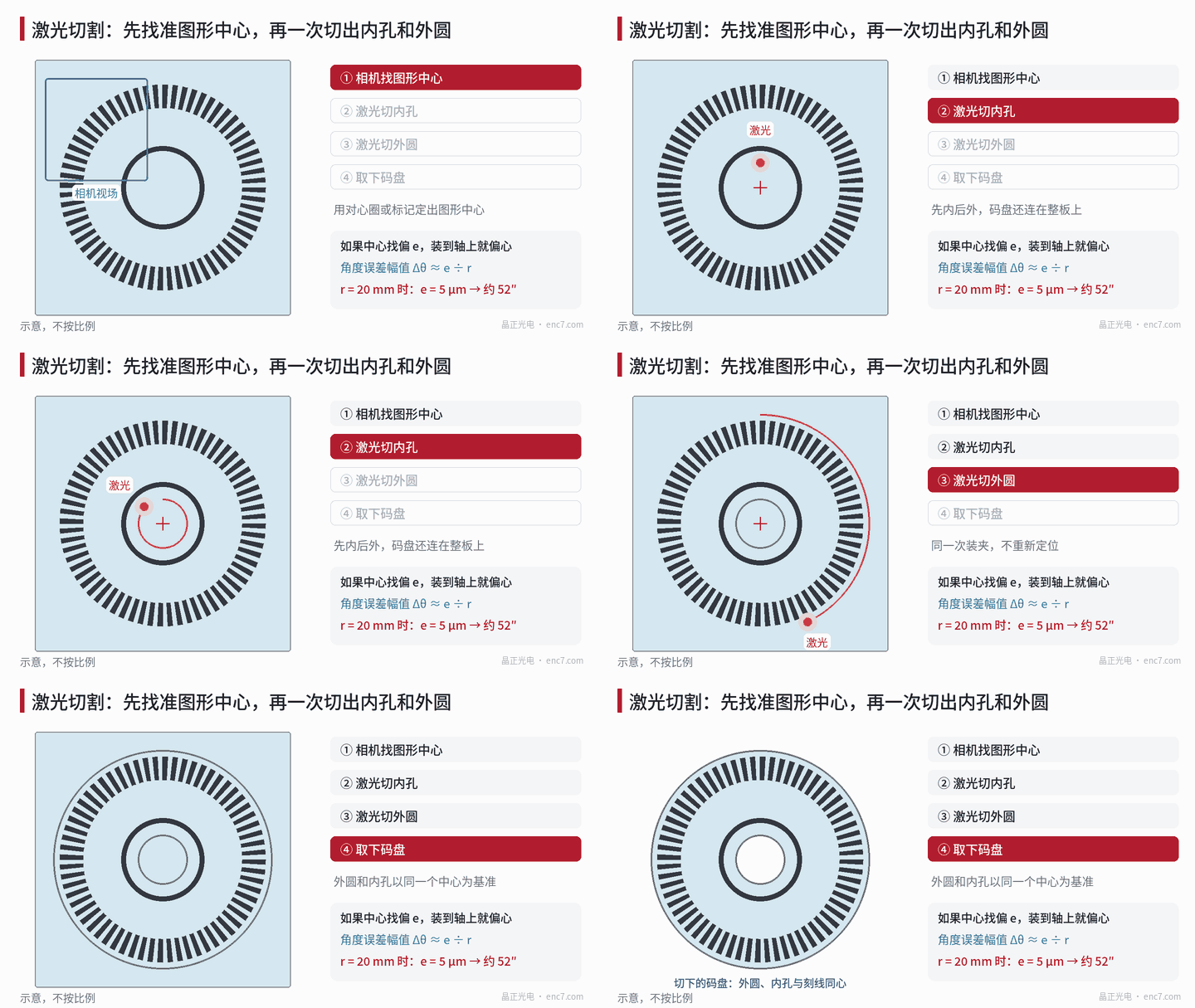
This is what encoder discs care about most. See Figure 1: before cutting, a camera recognises the centring ring or marks on the pattern, computes the pattern centre, then in the same fixturing cuts the inner hole and the outer circle about that centre. One practice is to cut the inner hole first and the outer circle second, so that while the hole is cut the disc is still attached to the plate and cannot shift.
Why does concentricity matter so much? If the customer locates on the inner hole or the outer circle for assembly, any cutting offset e becomes eccentricity directly and produces a once-per-revolution sinusoidal error of amplitude about e ÷ r:
| Read radius r | Eccentricity 1 μm | Eccentricity 5 μm |
|---|---|---|
| 20 mm | about 10″ | about 52″ |
| 10 mm | about 21″ | about 103″ |
Even when the customer centres under a microscope on the centring ring, a concentric outer circle and inner hole give more uniform fit clearance and make alignment easier.
Advantage two: free contour, no contact force
The laser path is set by the program. Outer circles, inner holes, notches, flats and shaped holes can all be cut; changing a disc type means changing the program, not making a special tool. There is no tool pressing on the glass, so no clamping distortion, tool wear or coolant contamination – especially friendly to thin glass.
The cost: heat-affected zone and post-processing
Lasers are not free of side effects. Near the cut there is a heat-affected zone that may leave microcracks, residual stress and a little debris. So:
- Keep a safe distance between the pattern and the cut line;
- Tune cutting parameters to the material and inspect the edge on the first piece;
- After cutting, edge-grind and chamfer to remove microcracks at the cut;
- Clean again to remove debris and dust.
Why edge grinding and chamfering decide how long a disc lasts is covered in the next article.
Summary
Glass encoder discs are not cut with a tool mainly because a laser can, in one setup, cut inner hole and outer circle about the pattern centre, without contact force and without contour limits. The cost is a heat-affected cut that needs edge grinding and cleaning to finish. The smaller the read radius, the tighter the demand on cutting concentricity.
Translated from the ENC7 Chinese technical library (article 0027). Read the Chinese original. Need a disc built to your drawing? Request a quote or see our custom encoder discs.
© Langfang Jingzheng Optoelectronic Technology Co., Ltd. All rights reserved. This article was created with AI assistance.