Materials
Metal Encoder Discs: Shock-Resistant Reflective Code Wheels

Metal encoder discs usually use stainless steel as the substrate. Polished mirror areas are the reflective zones, rough or light-absorbing areas are the non-reflective zones, and the readhead reads the signal from the difference in reflectance between them. They resist shock and vibration and can be made thin, but are more sensitive to flatness and surface condition. This article covers their structure, advantages and points to watch in use.
When equipment vibrates heavily and takes occasional shocks, or the axial space left for the encoder at the back of a motor is only a few millimetres, a glass disc struggles: glass is brittle, dislikes shock and is hard to make very thin. Metal discs are designed for exactly these cases. They mostly use stainless steel and a reflective optical path.
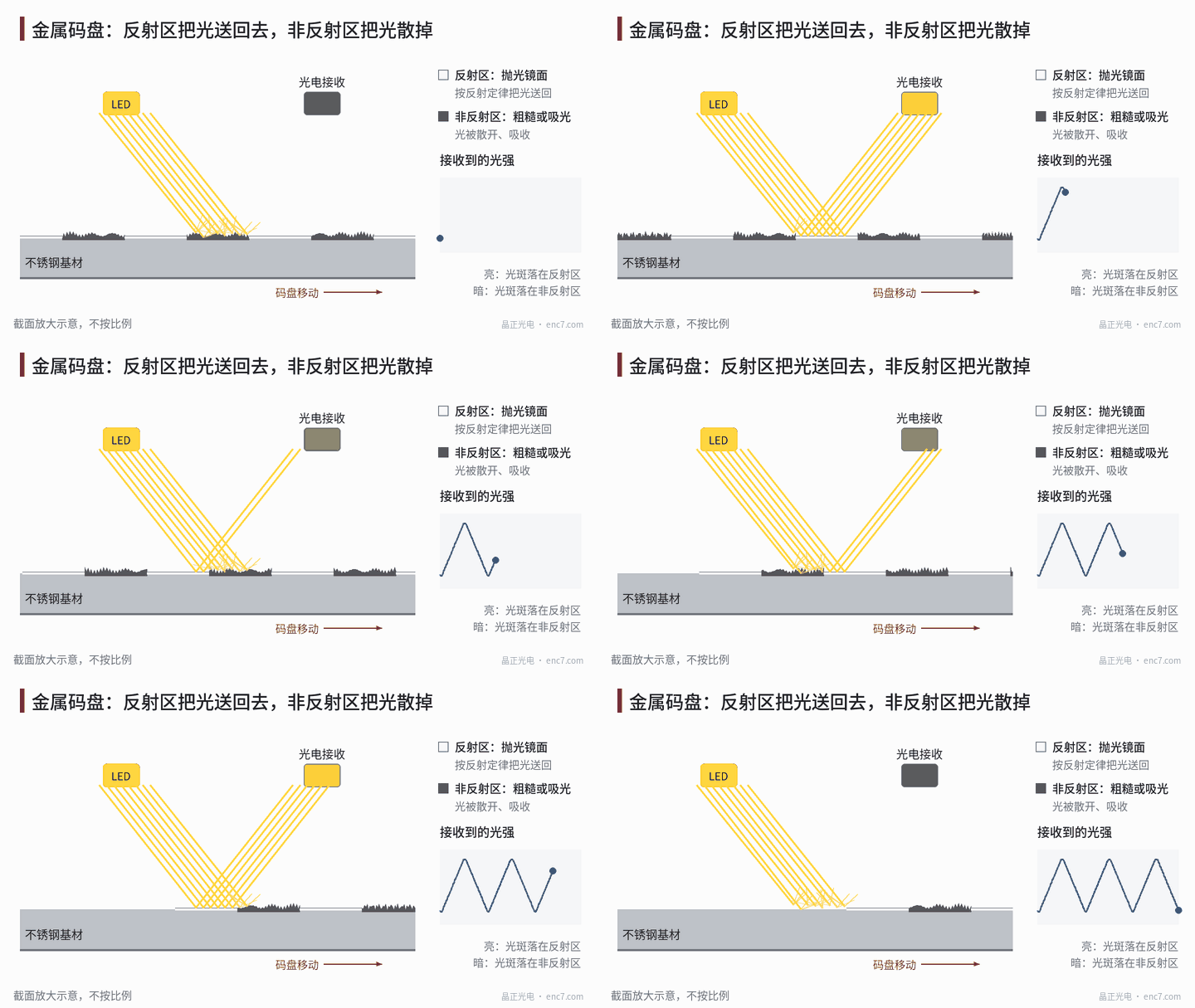
One sheet of stainless steel, two surfaces
Metal does not transmit light, so a metal disc forms its pattern not by “transmit / block” but by “reflect / don’t reflect”:
- Reflective areas: polished mirror surface. Light is reflected in one direction by the law of reflection, straight into the readhead’s detector.
- Non-reflective areas: either a rough surface that scatters light in all directions, or a low-reflectance absorbing film that soaks it up. Both can be made into fine patterns by photolithography and etching.
As the disc rotates, the light spot alternates between the two surfaces and the detector receives a bright-dark signal (Figure 1).
Signal contrast depends on the difference in reflectance between the two surfaces. Using modulation M = (Imax − Imin) ÷ (Imax + Imin): if the reflective area returns 1 and the non-reflective area 0.1, M = 0.9 ÷ 1.1 ≈ 0.82; if the non-reflective area is poorly made and returns 0.3, M drops to about 0.54. So whether the non-reflective area is “dark enough” matters as much as whether the reflective area is “bright enough”.
Advantages: shock resistance and thinness
- Shock- and vibration-resistant: metal is tough and does not chip or shatter under impact as glass can.
- Can be thin: a thin sheet still has enough strength, suiting designs with tight axial space.
- Single-side reading: in a reflective design source and detector are on the same side of the disc, so the readhead need not straddle it, giving more flexible assembly space.
- Better match with metal hubs: stainless steel expands at about 16–17 ×10⁻⁶/K and aluminium alloy at about 23; compared with soda-lime glass at about 9, the thermal expansion mismatch with an aluminium hub is smaller.
Watch-out 1: flatness
Thin metal sheet warps easily. Reflective reading is fairly sensitive to gap; when the disc is warped, the read gap varies with angle and the signal amplitude fluctuates with it (Figure 2).
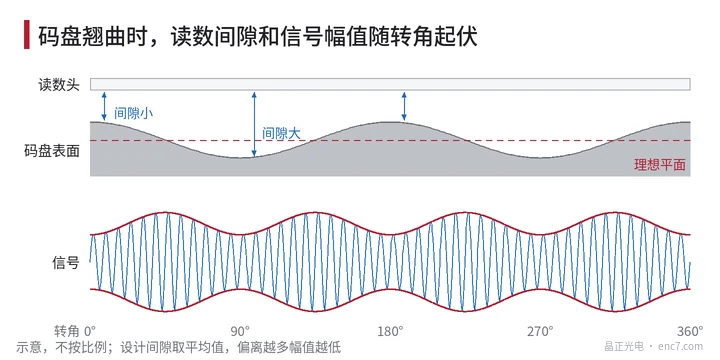
In addition, if the reflective surface tilts by α the reflected beam deflects by 2α and the spot may move off the detector. So the metal disc’s flatness and its axial runout after assembly must both be controlled.
Watch-out 2: surface condition
A reflective signal depends directly on surface reflectance. Fingerprints, oil films, oxidation and scratches all change reflectance, making the signal weaker or uneven. Stainless steel resists corrosion, but the polished mirror is still vulnerable to contamination: handle with gloves or finger cots and touch only the edge, store protected from moisture, and clean with suitable methods.
Temperature changes also matter: for a stainless disc with a 60 K rise, the radius at 20 mm grows about 19.2 μm, which affects the gap of a reflective readhead.
Where it fits
- Equipment with significant vibration and shock;
- Motors and modular encoders with tight axial space that need a thin structure;
- Designs where the disc and readhead are mounted separately and single-side reading is needed.
When very high line counts and accuracy are needed, glass discs are still more common; weigh the choice together with the disc manufacturer.
Summary
A metal disc uses a stainless steel substrate and forms its signal from the reflectance difference between a polished mirror and a rough or absorbing surface. It resists shock and vibration and can be made thin, at the cost of greater sensitivity to flatness and surface condition. Using metal discs well comes down to controlling warp and protecting the mirror surface.
Translated from the ENC7 Chinese technical library (article 0016). Read the Chinese original. Need a disc built to your drawing? Request a quote or see our custom encoder discs.
© Langfang Jingzheng Optoelectronic Technology Co., Ltd. All rights reserved. This article was created with AI assistance.