Materials
PC (Polycarbonate) Encoder Discs: Where Plastic Code Wheels Fit
PC (polycarbonate) encoder discs are light, hard to break and low-cost, suitable for high-volume production; but their coefficient of thermal expansion is about 7–8 times that of soda-lime glass, and their heat resistance and accuracy are lower than glass. This article uses worked examples to explain the strengths and weaknesses of PC discs and where they do and do not fit.
Open up the small encoder in a printer and you will often find a thin, light plastic disc. Unlike a glass disc it does not mind being dropped, and it is cheap — yet it is rarely seen in high-precision servo motors. Where a PC disc fits depends on the character of the material itself.
What a PC disc is
PC, polycarbonate, is a transparent, tough engineering plastic. PC discs are mostly transmissive: the substrate transmits light and the pattern on the disc blocks it, the same reading principle as a glass disc.
Strengths: light, drop-resistant, cheap
- Light: plastic is lighter than glass, so the disc has low moment of inertia — friendly to small motors and low-power equipment.
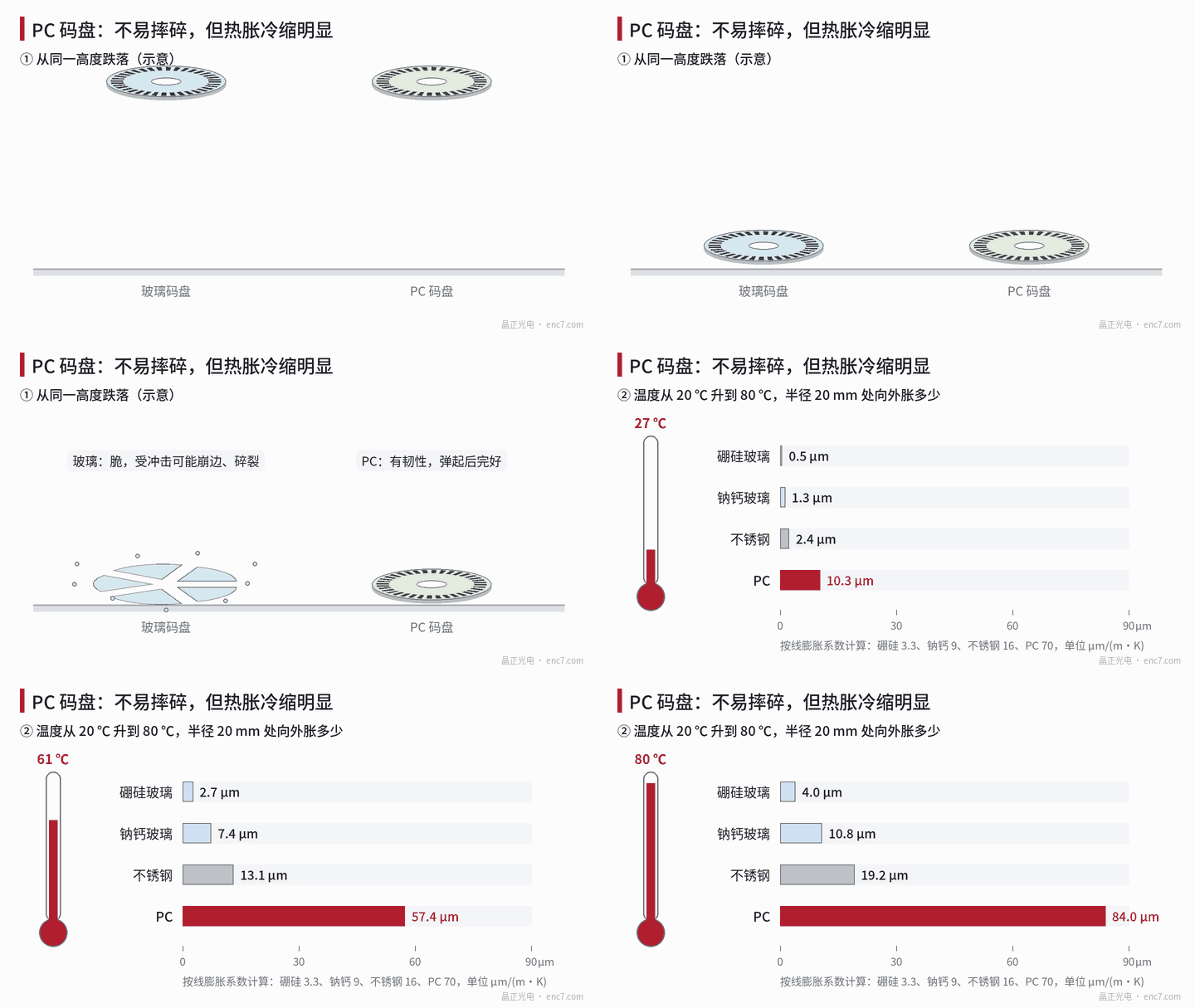
- Hard to break: PC is tough and does not easily shatter or chip when dropped or knocked (Figure 1, top). Losses in shipping and assembly are also lower.
- Low cost: suited to high-volume, low-cost production, with an advantage in unit cost.
Weakness 1: large thermal expansion
PC’s coefficient of linear expansion is about 65–70 ×10⁻⁶/K, versus about 9 for soda-lime glass and about 3.3 for borosilicate glass. The change in radius at r = 20 mm for a 60 K rise:
| Material | Change in radius |
|---|---|
| Borosilicate glass | about 4.0 μm |
| Soda-lime glass | about 10.8 μm |
| Stainless steel | about 19.2 μm |
| PC (taking 70) | about 84 μm |
When the disc expands uniformly the angular positions of the lines do not change; the problems lie elsewhere:
- It expands differently from the hub and shaft. Suppose the disc is bonded to an aluminium hub at radius 5 mm. Aluminium expands at about 23, so with a 60 K rise the radius difference is about (70 − 23) × 10⁻⁶ × 5 mm × 60 ≈ 14 μm. The adhesive layer takes this difference; after repeated thermal cycling it can cause stress, adhesive creep or a change in eccentricity.
- The track moves outward as a whole. With a 60 K rise, the track at radius 20 mm moves out about 84 μm. With the readhead fixed, it now looks at material that used to be about 84 μm further in. The pitch is still 2πr ÷ N, so it does not mismatch the index grating; but for narrow tracks, or absolute discs with several tracks side by side, this margin must be allowed for radially.
- Non-uniform expansion. When injection-moulding shrinkage is uneven, the hub constrains the disc, or there is a large inner-to-outer temperature difference, different areas expand differently — and only then do the line angles truly shift.
Weakness 2: temperature, accuracy and surface
- Temperature: PC softens at a much lower temperature than glass. Long-term operating temperature must be confirmed for the specific material; it is not suitable near strong heat sources.
- Accuracy and line count: the material’s dimensional stability is lower than glass and it absorbs a little water, so PC discs are generally used with modest line counts and larger pitches. The larger the pitch, the smaller the share of the pitch taken by the same non-uniform deformation, and the smaller the effect.
- Surface: the PC surface is relatively soft and scratches easily; some organic solvents such as acetone can whiten or even crack PC, so confirm a solvent is suitable before cleaning.
Where it fits
| Application trait | PC disc | Glass disc |
|---|---|---|
| Cost-sensitive, high volume | Suitable | Higher cost |
| Risk of drops or shock | Suitable | Needs protection |
| Large temperature swings, high accuracy required | Less suitable | Suitable |
| High line count, small pitch | Limited | Suitable |
A typical example is the printer: the carriage uses a code strip and paper feed uses a code wheel, often on a plastic substrate. Other cost-sensitive motor speed and position sensing with modest resolution requirements also often considers PC discs.
Summary
PC discs are light, hard to break and low-cost; their weaknesses are large thermal expansion and lower heat resistance and accuracy than glass. For modest line counts, small temperature changes and cost-sensitive applications they are a good fit; for high resolution, high accuracy or high operating temperature, prefer glass or metal discs.
Translated from the ENC7 Chinese technical library (article 0015). Read the Chinese original. Need a disc built to your drawing? Request a quote or see our custom encoder discs.
© Langfang Jingzheng Optoelectronic Technology Co., Ltd. All rights reserved. This article was created with AI assistance.