Encoder-disc terminology
Position Noise and Effective Resolution: RMS, Peak-to-Peak, Bandwidth

Position noise can be stated as RMS or peak-to-peak; the peak-to-peak/RMS ratio changes with the number of independent samples 2BT, and RMS scales with the square root of bandwidth. This article derives position noise from amplitude, voltage-noise density and signal period, defines effective bits per revolution, explains why the same encoder can be quoted at 27.1 bits or 22.7 bits, and gives conversion and measurement methods.
Two datasheets: one says “position noise 0.009″ RMS”, the other “jitter-free resolution 22.7 bits”. One looks an order of magnitude better than the other, yet they may describe the same encoder at different bandwidths and on different statistical bases. The value of position noise depends on at least three things: the statistic (RMS or peak-to-peak), the measurement bandwidth and the record length. Starting from the noise of the analog front end, this article writes out how to convert between them.
From voltage noise to position noise
When white noise of standard deviation σ_V is added to each of the sine and cosine channels and the amplitude is A, the noise of the interpolated angle is σ_θ = σ_V/A (rad, electrical; derivation in the article on interpolation resolution limits in this library). In mechanical terms:
σ_pos = (Λ/2π) · σ_V/A = (Λ/2π) · (e_n/A) · √B
where Λ is the signal period (360°/N_s mechanical, or a linear displacement), e_n the voltage-noise density per channel (V/√Hz) and B the equivalent noise bandwidth. (Λ/2π)·e_n/A is the position-noise density.
Worked example (assumed): 2048 lines (Λ = 632.8″), differential amplitude A = 0.5 V (1 Vpp), e_n = 1.4 μV/√Hz. The position-noise density is about 2.82×10⁻⁴ ″/√Hz:
| Equivalent noise bandwidth B | σ_V | σ_V/A | Position noise RMS |
|---|---|---|---|
| 100 kHz | 443 μV | 8.9×10⁻⁴ | 0.089″ |
| 10 kHz | 140 μV | 2.8×10⁻⁴ | 0.028″ |
| 1 kHz | 44 μV | 8.9×10⁻⁵ | 0.0089″ |
Position noise is proportional to Λ, e_n and √B and inversely proportional to A. More lines shorten Λ, but the amplitude usually falls with them: in the imaging example of the MTF article in this library, reducing the pitch from 20 μm to 8 μm makes Λ 0.4 times as large while the amplitude drops to about 0.47 times, so position noise falls only to about 0.86 times.
RMS and peak-to-peak: the ratio changes with record length
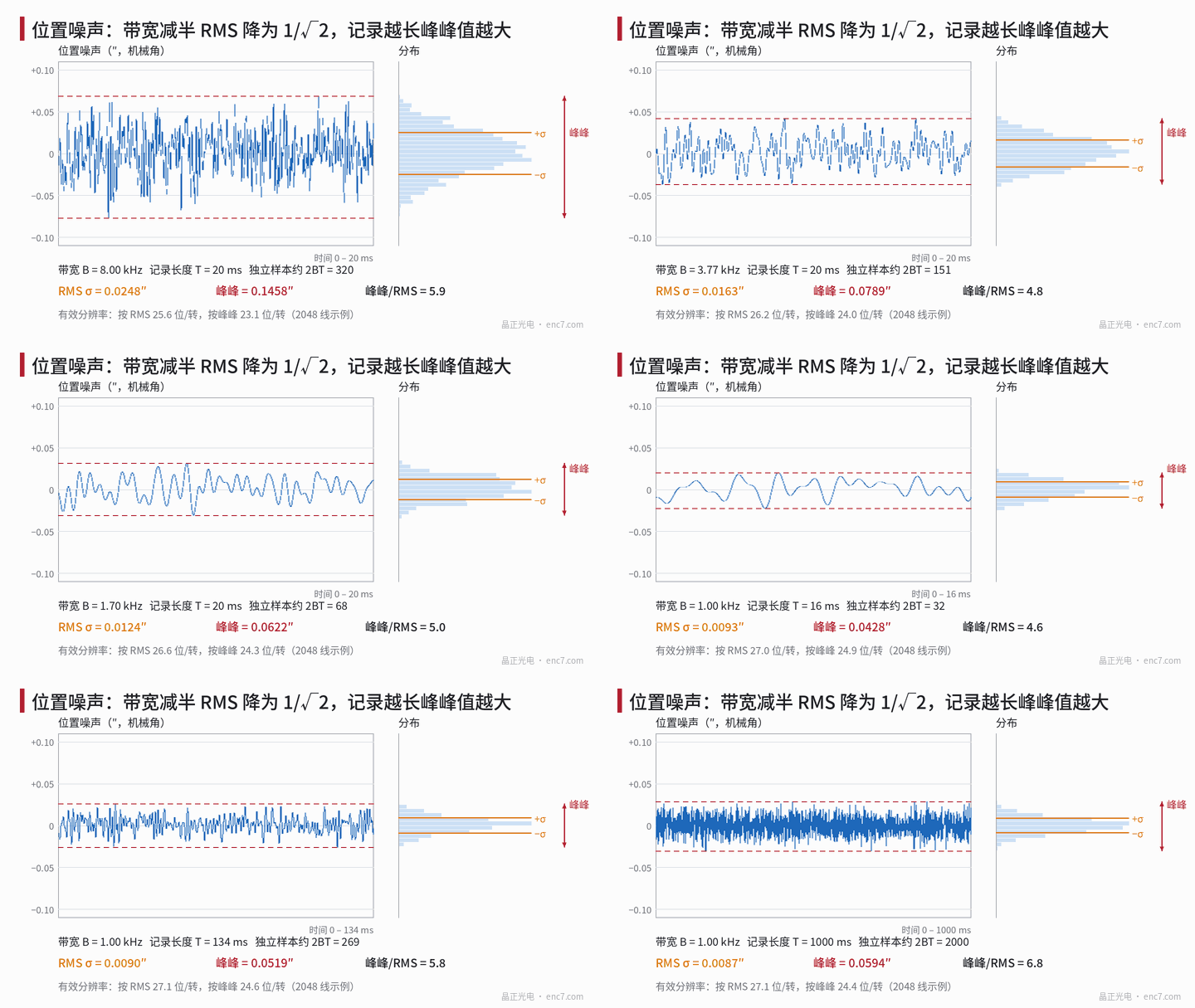
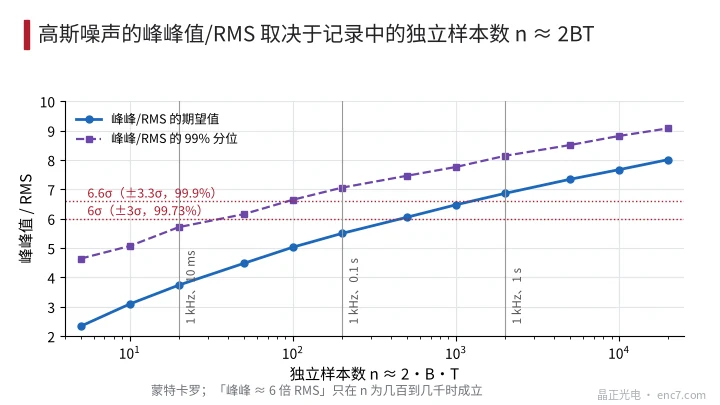
Gaussian noise has no fixed peak-to-peak multiple; it depends on how many independent samples the record contains. A signal of bandwidth B and record length T has about n ≈ 2BT independent samples, and the expected peak-to-peak/RMS ratio is:
| n | 20 | 200 | 2000 | 20 000 |
|---|---|---|---|---|
| Peak-to-peak/RMS | 3.7 | 5.5 | 6.9 | 8.1 |
At B = 1 kHz, records of 10 ms, 0.1 s and 1 s correspond to n = 20, 200 and 2000. “Peak-to-peak is about 6 times RMS” holds only when n is a few hundred to a few thousand (see Figure 2). Some sources define peak-to-peak by coverage probability: ±3σ (99.73%) is 6σ, ±3.3σ (99.9%) is 6.6σ, the latter often used to define “jitter-free” resolution. A peak-to-peak value in a specification should state whether it is “measured maximum minus minimum within record T” or “converted as 6.6σ”.
If the noise contains occasional interference spikes, peak-to-peak is set by a few events while RMS is insensitive to them; the ratio then departs far from the Gaussian value, which is itself a diagnostic signal.
Bandwidth: convert with the equivalent noise bandwidth
The RMS of white noise is proportional to the square root of bandwidth: halve the bandwidth and RMS drops to 1/√2. Conversions must use the equivalent noise bandwidth (ENBW), whose ratio to the −3 dB bandwidth depends on the filter:
- ideal low-pass: 1;
- second-order Butterworth: about 1.11;
- first-order RC: π/2 ≈ 1.57;
- moving average of length T_a: ENBW = 1/(2T_a).
A first-order filter with a “−3 dB bandwidth of 1 kHz” therefore gives about 25% more noise than an ideal 1 kHz low-pass. For an encoder with digital output the bandwidth is set by the internal tracking loop or filter; ask the supplier for the equivalent noise bandwidth.
Two further points. Lowering the sample rate is not the same as lowering the bandwidth: without filtering before sampling, high-frequency noise aliases in and RMS stays the same. And the √B law holds only in the white-noise region: 1/f noise at low frequencies and drift of temperature and light source do not fall with the square root of bandwidth, and the longer the record, the more drift gets mixed into the “noise”.
Effective resolution: several bases for bit counts
Referred to one revolution, the effective resolution defined by noise is
b = log₂(1 296 000″ / σ)
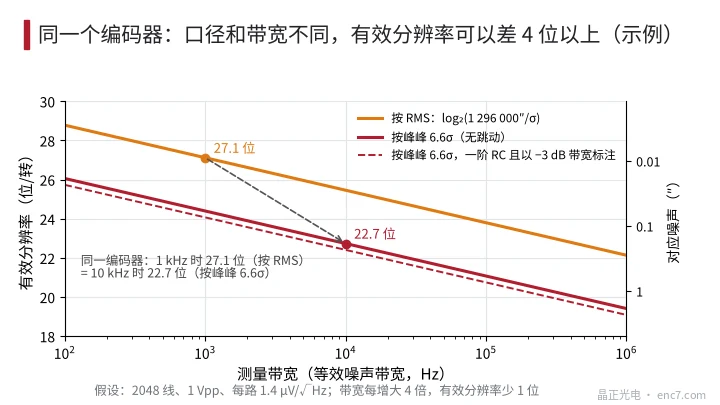
It also equals log₂(N_s) + log₂(2π/σ_θ), i.e. the bits of signal periods per revolution plus the effective bits of interpolation per period. Using peak-to-peak 6.6σ instead of σ gives “jitter-free” bits, log₂6.6 ≈ 2.72 bits fewer than b; with 6σ it is about 2.58 bits fewer. Each 4-fold increase in bandwidth costs 1 bit; a 10-fold increase costs about 1.66 bits.
The example encoder has 27.1 bits RMS at 1 kHz, 25.4 bits RMS at 10 kHz and 22.7 bits at 10 kHz on a 6.6σ peak-to-peak basis—three numbers for the same encoder (see Figure 3). The word length of the interface (for example 26 bits) is only a data format and is not the effective resolution; effective resolution is also unrelated to accuracy.
Measurement method
- Isolate mechanical motion: lock the shaft and isolate vibration, or use the difference between two readheads on the same disc to remove rig vibration;
- Raw data: record the interpolated position at a sample rate far above the bandwidth of interest, with a record long enough to cover the lowest frequency to be reported;
- Power spectrum: estimate the position-noise power spectral density by segment averaging, and locate the white-noise floor and the 1/f corner;
- Conversion: integrate the power spectrum over the required equivalent noise bandwidth to obtain σ(B); for peak-to-peak, state the record length or the conversion factor;
- Report: σ (″ RMS), ENBW, standstill or speed, temperature, peak-to-peak with T, and the basis of the effective bits per revolution.
When the noise is smaller than half the least significant bit of the output, the output sticks at one code or toggles between two codes and the σ estimate is biased; check the resolution margin first (for the effect of quantisation see the article on interpolation resolution limits in this library).
Engineering points
- Position noise must be stated with the statistic, the equivalent noise bandwidth and the record length; without any one of them it cannot be compared.
- Position-noise density (Λ/2π)·e_n/A is independent of bandwidth and suits comparison across products.
- The peak-to-peak/RMS ratio rises with n ≈ 2BT, from 3.7 (n = 20) to 8.1 (n = 20 000); do not convert with a fixed factor of 6.
- Convert bandwidth by ENBW: for a first-order RC the ENBW is 1.57 times the −3 dB bandwidth, giving about 25% more noise.
- State effective bits per revolution: b = log₂(1 296 000″/σ); subtract 2.72 bits for a peak-to-peak 6.6σ basis and 1 bit for each 4-fold increase in bandwidth.
- When adding lines to reduce position noise, account for the drop in amplitude: estimate the modulation depth at the smaller pitch first.
Summary
Position noise is set by front-end voltage noise, signal amplitude and signal period; RMS scales with the square root of the equivalent noise bandwidth, and peak-to-peak also grows with record length. With a different bandwidth and statistical basis, the effective resolution of the same encoder can be quoted anywhere from 27 bits down to just over 22 bits. Only when statistic, bandwidth and record length are all written into the specification, and conversions are made by ENBW and sample count, can figures from different sources be compared.
Translated from the ENC7 Chinese technical library (article 0270). Read the Chinese original. Need a disc built to your drawing? Request a quote or see our custom encoder discs.
© Langfang Jingzheng Optoelectronic Technology Co., Ltd. All rights reserved. This article was created with AI assistance.