Introduction to encoder principles
Resolution, Accuracy and Repeatability: Three Specs That Are Easy to Confuse
A 17-bit encoder has about 9.9″ per count — does that mean it is accurate to 9.9″? Not necessarily. Resolution is how fine the scale is; accuracy is how far the reading is from the true value; repeatability is how consistent the readings are when the same position is reached again. This article uses a target-shooting analogy and numerical encoder examples to make the three specifications clear.
Encoder datasheets often list resolution, accuracy and repeatability side by side. A remark one often hears is: “It is a 17-bit encoder, 9.9″ per count, so it is accurate to 9.9″.”
That sentence treats resolution as if it were accuracy. The three specifications describe three different things; a target-shooting analogy makes them easiest to see.
Understanding the three with a target
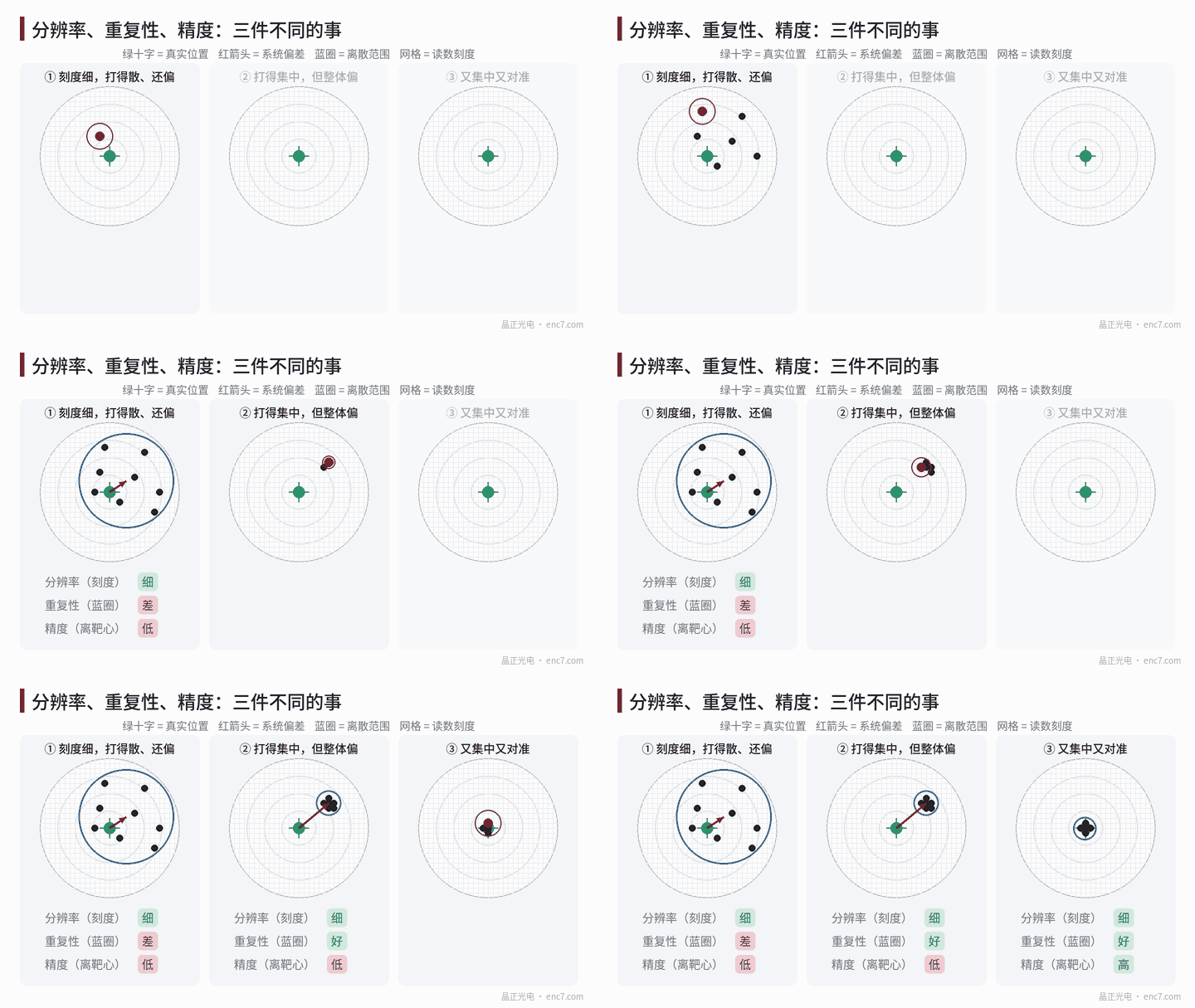
Take the centre of the target as the true position, the bullet holes as the encoder readings, and the grid on the target as the reading scale; see Figure 1:
- Resolution is how fine the grid is. The finer the grid, the finer the position that can be reported. A fine grid does not mean the shots are accurate.
- Repeatability is how tightly the holes are grouped. It corresponds to the difference among readings when the encoder returns to the same position several times.
- Accuracy is how far the holes are from the centre. It includes both the overall offset (systematic deviation) and the scatter of the holes.
The three targets have equally fine grids, yet the results are entirely different: the first is both scattered and offset, the second is tightly grouped but offset as a whole, and only the third is both tight and on centre.
Resolution: the smallest step that can be distinguished
Resolution is set by the counts per revolution: angular resolution = 360° ÷ counts per revolution. A 1000-line disc with fourfold decoding is 0.09° (324″); 17 bits is about 9.9″; 23 bits is about 0.15″.
Resolution only says how fine the “scale” of the reading is; it does not say whether the reading equals the true angle.
Accuracy: how far the reading is from the true value
Accuracy is the maximum deviation, over one full revolution, between the reading and the true angle. It comes from many places: position errors of the lines on the disc, mounting eccentricity of the disc, bearing runout, errors in the interpolation circuit, and so on.
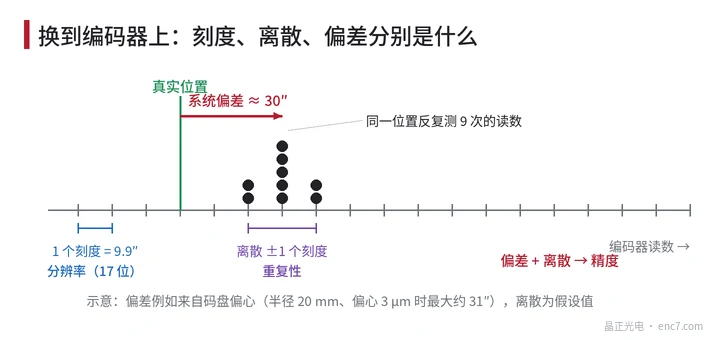
Eccentricity is the most typical item. Disc eccentricity e, at a reading radius r, produces a once-per-revolution sinusoidal error of amplitude Δθ ≈ e ÷ r. At a radius of 20 mm and an eccentricity of 3 μm, the error reaches about 31″ at most.
In other words, on a 17-bit encoder, if the disc is mounted 3 μm off centre, the scale of the reading is 9.9″, but the reading can be as much as 31″ away from the true value — more than 3 counts; see Figure 2.
Repeatability: how consistent the readings are when the same position is reached again
Repeatability is the spread of the readings when the shaft is brought back to the same position several times. It is affected mainly by noise, mechanical backlash, short-term temperature changes, and the like.
Repeatability is often much better than accuracy, because systematic errors such as eccentricity and line-position error are the same every time and repeat unchanged when the same position is reached: they affect accuracy but not repeatability. That also brings a benefit: systematic errors can be measured and compensated. If a higher-accuracy reference is used to measure the error curve over one revolution and the curve is stored in the controller for correction, accuracy can be improved substantially. The premise is good repeatability; otherwise the measured error curve will not be valid the next time.
How to read the specs when selecting
- If the machine is taught and only needs to return to the same position each time, look first at repeatability;
- If the machine must be positioned absolutely in coordinates — for example measurement, or machining to a program — look first at accuracy;
- For smooth motion at low speed and for small increments, sufficient resolution is needed;
- Definitions in datasheets are not identical from one manufacturer to another: some quote a ± value, some a peak-to-peak value, some include mounting error and some do not. Compare the definitions before comparing the numbers.
In brief
Resolution is how fine the scale is; repeatability is how tightly the readings are grouped; accuracy is how far the reading is from the true value. High resolution is not the same as high accuracy, and good repeatability is not the same as high accuracy either. The quality of the lines on the disc and the mounting eccentricity directly determine the accuracy, and good repeatability is the premise for error compensation.
Translated from the ENC7 Chinese technical library (article 0009). Read the Chinese original. Need a disc built to your drawing? Request a quote or see our custom encoder discs.
© Langfang Jingzheng Optoelectronic Technology Co., Ltd. All rights reserved. This article was created with AI assistance.