Glass & substrate science
Specific Stiffness and Substrate Choice: Deflection and Natural Frequency of Same-Size Discs in Different Materials
For equal disc size the first natural frequency scales as √(E/ρ), and self-weight deflection satisfies w ≈ 1.2g/(2πf₁)², independent of material. Using the exact annular-plate solution this article computes f₁ and sag for six substrates (example Ø200 mm, 2 mm), compares thickness and mass at equal frequency, and gives selection guidance for large-diameter discs.
Once discs get larger and thinner, whether the face sags or shakes matters as much as line accuracy: reflective and small-gap readheads are sensitive to axial face position, so self-weight sag and vibration both become gap changes. A common suggestion is to “switch to a stiffer material”, yet Young’s moduli of glass, sapphire and silicon differ by factors, densities differ too — which quantity should one look at? This article clears deflection and natural frequency with an annular-plate model. Only one quantity matters: specific stiffness E/ρ, and deflection and frequency are two statements of the same thing.
Model: two formulas and one identity
The disc is clamped on a hub. Treat it as a thin annular plate with inner edge (clamp radius a) fixed and outer edge (radius R) free, thickness t. Flexural rigidity
D = E·t³ / [12(1 − ν²)]
First natural frequency
f₁ = λ² / (2πR²) · √(D / ρt) = λ² / (2πR²·√(12(1 − ν²))) · t · √(E/ρ)
where λ² is the frequency coefficient from the exact Bessel-function solution: 4.80 at ν = 0.2, a/R = 0.2, and 5.59 at a/R = 0.25. The lowest mode is a rocking shape with 1 nodal diameter, 2%–6% below the axisymmetric umbrella mode. With the face horizontal under self-weight ρg·t alone, outer-edge sag is
w = α·ρg·t·R⁴ / D = 12α(1 − ν²)·g·R⁴·ρ / (E·t²)
α depends only on geometry: about 0.054 at a/R = 0.2, about 0.043 at 0.25. Comparing the two formulas: f₁ ∝ (t/R²)·√(E/ρ), w ∝ (R⁴/t²)·ρ/E; material enters only through E/ρ (and a near-1 1 − ν² correction). Combining them:
w ≈ κ·g / (2π·f₁)², κ ≈ 1.2–1.4
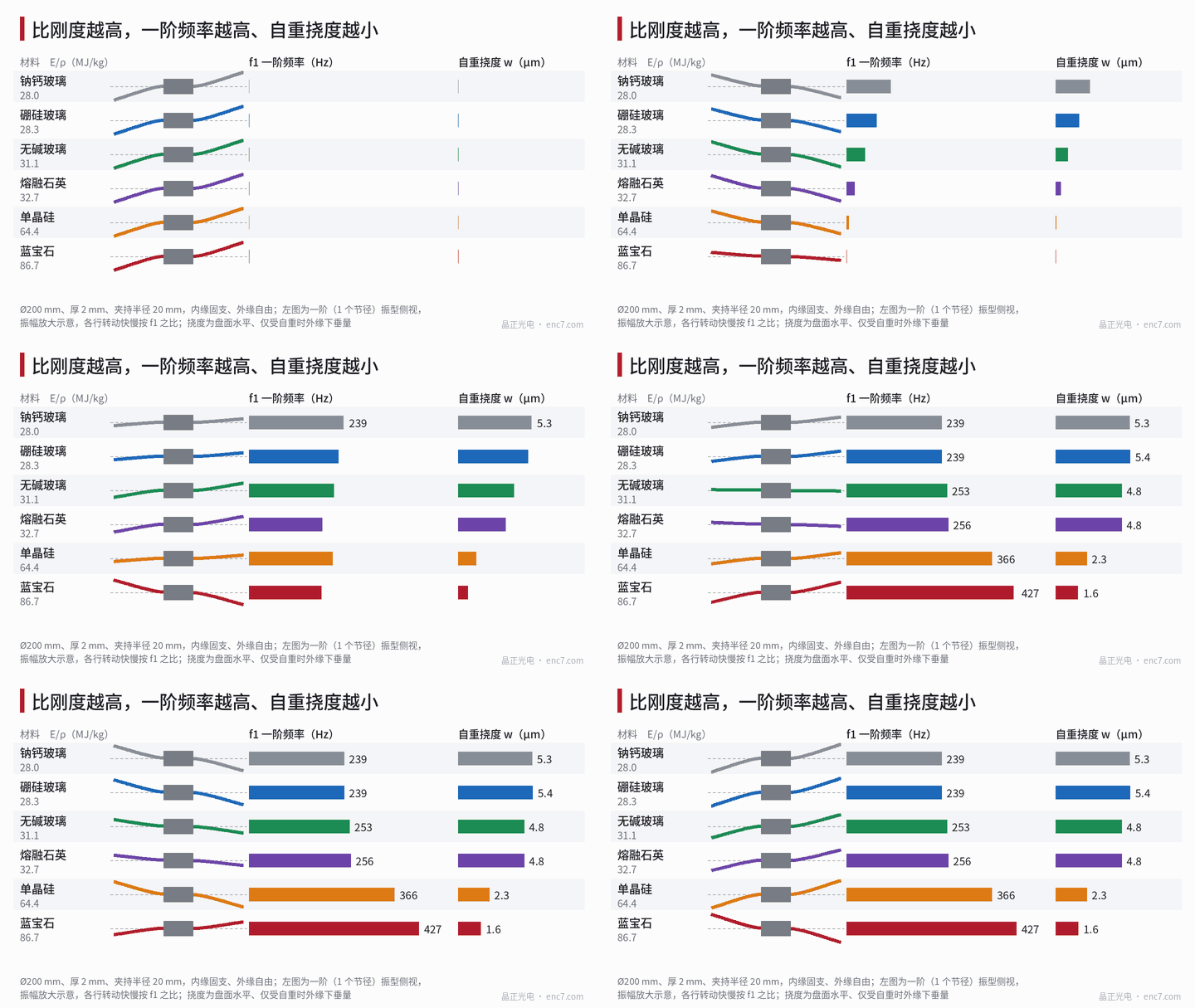
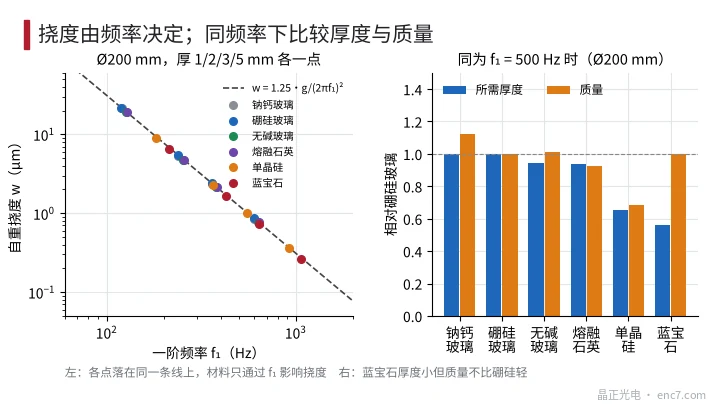
κ is set by geometry and is material-independent. Self-weight deflection is simply “g over angular frequency squared”: a disc at f₁ = 240 Hz sags about 5.4 μm, at 100 Hz about 31 μm. So do not treat deflection and frequency as two metrics — knowing f₁ gives the self-weight sag (Figure 3, left: all points fall on one line).
Worked example: Ø200 mm, 2 mm thick
Assume outer diameter 200 mm, clamp radius 20 mm, thickness 2 mm, face horizontal. Materials take typical values (sapphire of a-axis order, anisotropy about ±10%; single-crystal silicon the mid-value of 130–169 GPa; alkali-free glass as an order of magnitude):
| Material | E (GPa) | ρ (g/cm³) | E/ρ (MJ/kg) | f₁ (Hz) | Outer self-weight deflection (μm) |
|---|---|---|---|---|---|
| Soda-lime glass | 70 | 2.50 | 28.0 | 239 | 5.4 |
| Borosilicate glass | 63 | 2.23 | 28.3 | 239 | 5.4 |
| Alkali-free glass | 74 | 2.38 | 31.1 | 253 | 4.8 |
| Fused silica | 72 | 2.20 | 32.7 | 256 | 4.8 |
| Single-crystal silicon | 150 | 2.33 | 64.4 | 366 | 2.3 |
| Sapphire | 345 | 3.98 | 86.7 | 427 | 1.7 |
Among the four glasses E/ρ differs by only about 20%, f₁ by about 7%; switching soda-lime to fused silica gains almost no stiffness. Sapphire and silicon have E/ρ 2–3 times that of glass, f₁ rises 1.5–1.8× and sag falls to about 0.3–0.4×.
Scaling laws matter more: doubling outer diameter cuts f₁ to 1/4 and multiplies sag by 16; doubling thickness doubles f₁ and cuts sag to 1/4. The same borosilicate disc at Ø200 mm, 1 mm thick has only about 120 Hz and about 22 μm sag; at Ø80 mm, 1 mm thick (clamp radius 10 mm), f₁ is about 870 Hz and sag only 0.44 μm — small discs need no worry.
Equal-frequency design: sapphire gets thinner, but not lighter
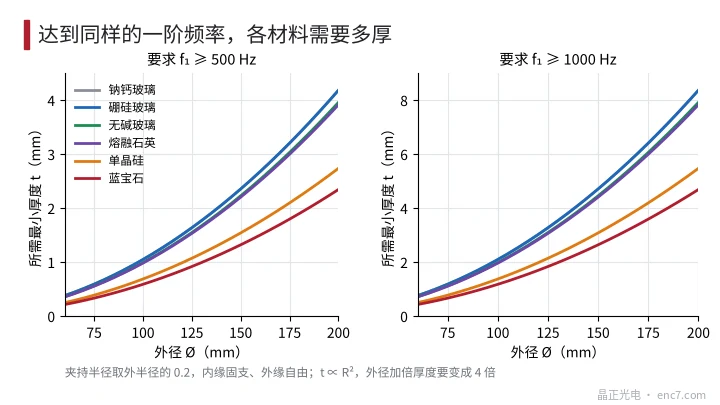
Require f₁ ≥ 500 Hz and invert for thickness:
t_min = 2πR²·f₁ / λ² · √(12(1 − ν²)ρ / E)
At Ø200 mm, borosilicate and soda-lime need about 4.2 mm, fused silica about 3.9 mm, silicon about 2.7 mm, sapphire about 2.3 mm (Figure 2). Mass ∝ ρ·t ∝ ρ^1.5/√E; relative to borosilicate: sapphire about 1.00, fused silica 0.92, silicon 0.68, soda-lime 1.12. Sapphire is thinner but denser, so at equal frequency it is no lighter and rotary inertia does not improve; silicon is about three-tenths lighter yet nearly opaque at 850–950 nm near-IR, usable only for reflective or slotted patterns (see another article in this library).
Beyond specific stiffness: clamp radius and speed
Clamp radius. Raising a/R from 0.2 to 0.4 lifts λ² from 4.80 to 9.07, nearly doubles f₁, drops α from 0.054 to 0.018 and cuts sag to about one third. Enlarging the hub bond-ring radius is cheaper than thickening the disc or changing material — provided the read tracks are not blocked by the hub.
Rotational speed. Centrifugal stress scales as ρω²R², independent of E. In a free-hole approximation, borosilicate Ø200 mm at 6000 r/min has about 7 MPa hoop stress at the hole edge, about 79 MPa at 20000 r/min (excluding assembly and bond stress). So at low-to-medium speed the selection limit is stiffness and vibration; only at high speed do specific strength and edge defects take over. Also keep rotational frequency and its low harmonics clear of f₁; spinning further splits nodal-diameter modes in the lab frame, which must be checked with a rotating-disc model.
Engineering notes
- Compute f₁ first, then estimate self-weight sag with w ≈ 1.2g/(2πf₁)²; only when the face is horizontal and gap tolerance is within tens of micrometres is a check needed.
- Do not switch among glasses for stiffness: E/ρ differs by only about 20%. Raise f₁ by thickening (f₁ ∝ t), shrinking outer diameter (∝ 1/R²) or enlarging clamp radius.
- Actually compute f₁ for large thin glass discs: same borosilicate, Ø150 mm × 3 mm is about 640 Hz, Ø200 mm × 2 mm only about 240 Hz.
- Equal-frequency comparisons must look at mass and inertia, not thickness alone: sapphire thinner does not mean lighter.
- Sapphire and silicon E vary with crystal direction; table numbers are order-of-magnitude — ask the supplier for orientation and measured modulus before freezing the design.
- Real f₁ depends on bond-ring stiffness and is lower than ideal clamp; validate on samples by tap or laser vibrometry.
Summary
For equal-size discs the first natural frequency scales with √(E/ρ) and self-weight deflection with ρ/E, and w ≈ κg/(2πf₁)² joins the two into one fact. Specific-stiffness differences among glasses are small, so material choice brings little change; sapphire and silicon can raise f₁ by about 1.5–1.8×, but sapphire does not reduce mass and silicon is limited by near-IR opacity. Stiffness of large-diameter discs is won mainly from thickness, outer diameter and clamp radius.
Translated from the ENC7 Chinese technical library (article 0572). Read the Chinese original. Need a disc built to your drawing? Request a quote or see our custom encoder discs.
© Langfang Jingzheng Optoelectronic Technology Co., Ltd. All rights reserved. This article was created with AI assistance.