Manufacturing
The Photomask: the “Negative” of the Disc Pattern
Every line on an encoder disc is copied from a photomask. How the mask is made, how its accuracy and defects transfer to every disc, why master and working masks are split, and how to extend mask life – this article covers each in turn.
When a disc type goes into volume production, thousands of pieces may be made, yet their lines all come from the same source: the photomask. The mask is like a photographic negative – whatever is on the negative appears on every print, the good and the bad alike.
What a photomask is
A photomask is a flat glass plate with a chrome pattern on its surface – structurally very similar to a glass encoder disc itself. For 1:1 replication such as encoder discs, the pattern on the mask is the same size as on the disc; a single plate often carries several disc patterns so one exposure makes several pieces.
Common substrate materials are soda-lime glass and fused silica (quartz glass). The linear expansion coefficient of fused silica is about 0.5 × 10⁻⁶/K, that of soda-lime glass about 9 × 10⁻⁶/K. For a 1 K temperature change at a radius of 20 mm, the dimensional change of a soda-lime mask is about 0.18 μm, while fused silica changes by only about 0.01 μm. A uniform proportional expansion does not change the angular position of the lines, and the pitch at a fixed radius stays the same, but the track radius follows the expansion – printed onto the disc that means the track leaves the design radius; if the mask temperature is uneven, expansion differs from place to place and directly produces angular error. So high-accuracy work commonly uses fused-silica masks and controls temperature during exposure.
How a photomask is made
The first mask has no “negative” to copy from; it can only be “drawn” directly from the design data. The usual route is laser or electron-beam direct write: the tool scans point by point and line by line according to the data, exposes a chrome-coated plate with resist, then development, etching and resist strip yield the chrome pattern. For circular patterns there is also a method in which the substrate rotates on a precision turntable and lines are written in polar coordinates; angular accuracy of the lines then depends on the turntable and the angle-measuring system.
A finished mask is inspected item by item: line width, line position, concentricity of the pattern with the centring ring, and defects. Extra chrome spots and missing chrome can be repaired on dedicated tools and rechecked after repair.
How mask errors transfer to the disc
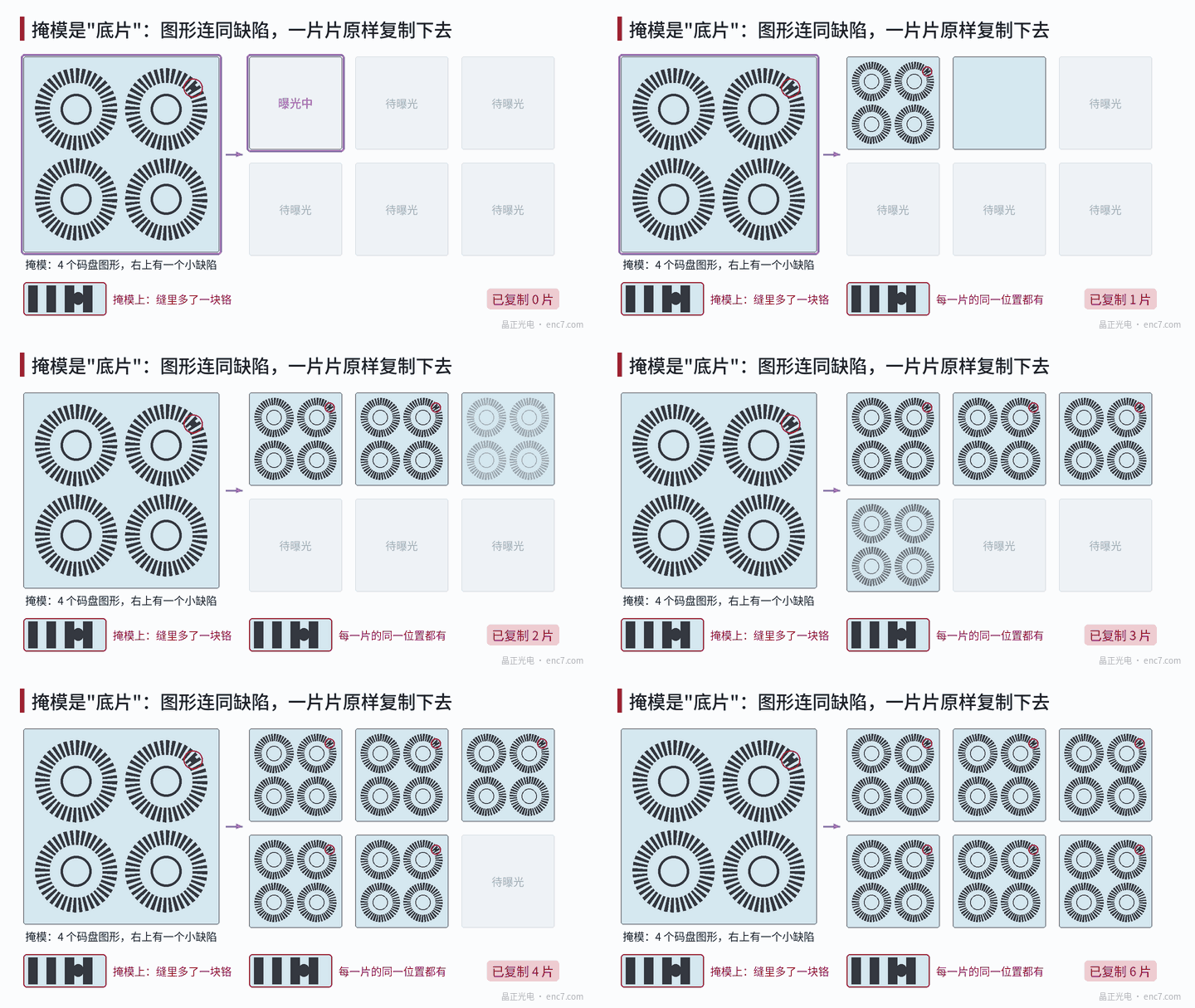
Photolithography is “copying”: problems on the mask appear unchanged on every disc (see Figure 2):
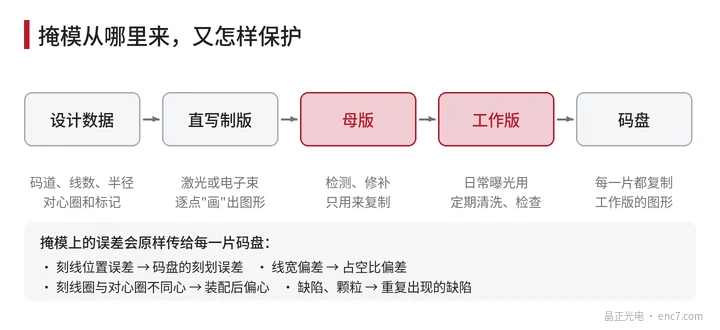
- Line-position error → graduation error on the disc, identical on every piece.
- Line-width deviation → duty-cycle deviation.
- Pattern and centring ring not concentric → the disc is still eccentric after assembly on the centring ring.
- Defects and particles → the same defect at the same place on every piece – see Figure 1.
This is both an advantage and a requirement. The advantage is consistency: discs from the same mask share almost the same error pattern. The requirement is that the mask itself must be distinctly more accurate than the disc specification, because subsequent exposure and etching only add error – they never improve it.
Master, working mask and mask life
In contact exposure the mask is pressed against the resist every time it is used, so it inevitably picks up resist and particles and can even be scratched. If the direct-written mask is used for production and then damaged, the whole patterning job has to be redone.
The usual practice is a two-level split: the direct-written plate is the master, carefully stored after it passes inspection and used only for copying; several working masks are copied from the master for daily production and replaced from the master when worn.
Mask maintenance can be summarised as a checklist:
- Clean at the prescribed count or interval to remove resist traces and particles;
- Inspect regularly under a light box or microscope for defects and scratches;
- Store in dedicated clean boxes; avoid stacking and bare-hand contact;
- When new defects exceed the allowed limit, retire and replace the working mask.
Mask life is not counted in calendar time; it is mainly a matter of use count and inspection results.
Summary
The photomask is the source of the disc pattern: its accuracy sets the upper limit of disc accuracy, and its defects repeat on every piece. Low-expansion substrates, strict patterning inspection, a master/working-mask hierarchy, and regular cleaning and inspection are the basis for batch after batch of consistent discs.
Translated from the ENC7 Chinese technical library (article 0026). Read the Chinese original. Need a disc built to your drawing? Request a quote or see our custom encoder discs.
© Langfang Jingzheng Optoelectronic Technology Co., Ltd. All rights reserved. This article was created with AI assistance.