Product range
Encoder discs and code wheels
Four product lines, one factory. Choose the substrate and optical path that fits your encoder — or send us your drawing and we will recommend one.
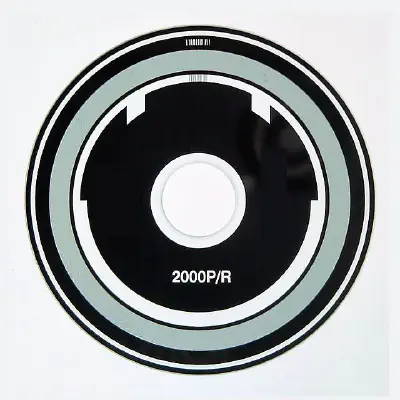 Transmissive · Chrome on glass
Glass Encoder Disc
Chrome-on-glass, photolithographic graduations. The first choice for high resolution and thermal stability.
Specifications →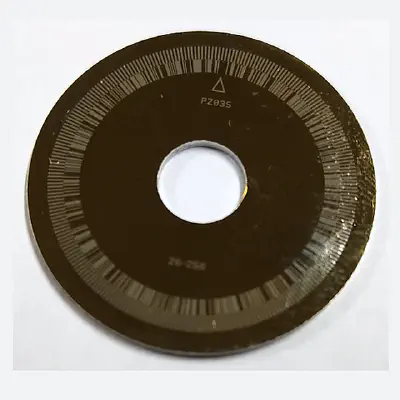 Reflective · Stainless steel
Reflective Metal Encoder Disc
Stainless steel, high/low-reflectance pattern. Thin, robust encoders for robot joints and slim servo motors.
Specifications →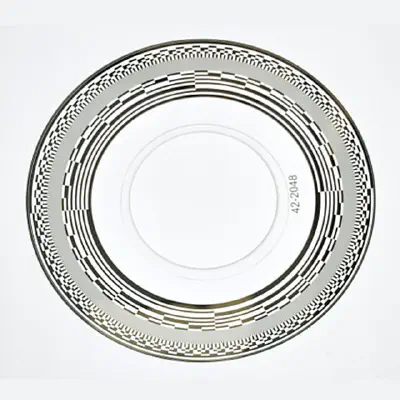 Transmissive · Polycarbonate
PC Encoder Disc
Polycarbonate, transmissive. Lightweight, tough and the lowest cost for high-volume encoders.
Specifications →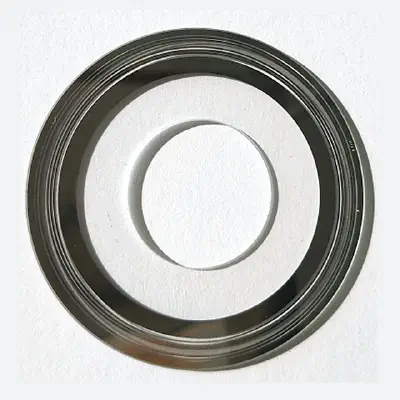 Built to drawing
Custom Encoder Disc
Your drawing, your tracks, your substrate. Incremental, absolute and sin/cos patterns made to order.
Specifications →How to choose a disc type
- Highest resolution and long-term accuracy, wide temperature range → glass encoder disc
- Thin encoder, vibration or shock, hollow shaft, robot joints → reflective metal encoder disc
- High volume, moderate resolution, weight- and cost-sensitive → PC encoder disc
- Special size, sin/cos tracks, absolute patterns or unusual coating → custom encoder disc
Still unsure? Order a small sample batch of two disc types and measure the signals with your own readhead — this is often the fastest way to decide. Our guide Reflective metal or glass encoder disc? explains the trade-offs.
| Criterion | Glass (chrome on glass) | Reflective metal | PC (polycarbonate) |
|---|---|---|---|
| Typical optical path | Transmissive | Reflective (source and detector on the same side) | Transmissive |
| High line counts / absolute multi-track | Easiest | Possible, limited by etching and coating | Moderate resolution |
| Thermal expansion (approx.) | Low — about 3.3 (borosilicate) to 9 (soda-lime) ×10⁻⁶/K | Higher — stainless steel about 16–17 ×10⁻⁶/K | Highest — about 65–70 ×10⁻⁶/K |
| Shock and vibration | Sensitive to drops and impact | Very good — does not shatter | Good — tough, not brittle |
| Encoder height | Needs space on both sides | Can be very thin | Needs space on both sides |
| Relative cost | Higher | Lower than glass | Lowest |
| Best for | CNC, rotary tables, metrology, high-resolution servo | Robot joints, slim servo motors, hollow-shaft encoders | High-volume, cost- and weight-sensitive encoders |