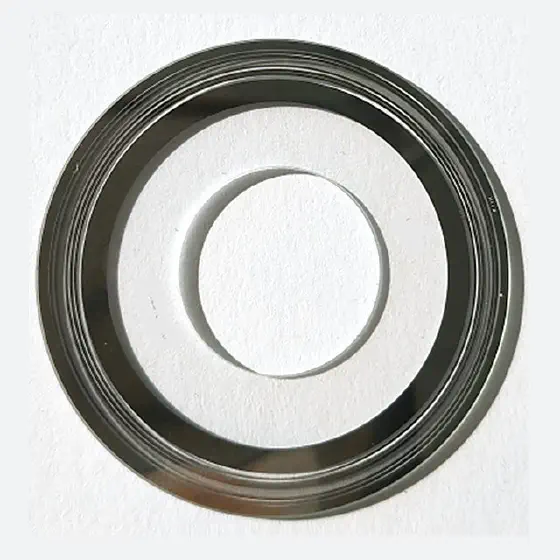
Built to drawing
Custom encoder discs and code wheels
A custom encoder disc is a code wheel built to the customer’s drawing rather than taken from a catalog — substrate, optical path, code pattern, dimensions, line count, coating and concentricity are all specified for one encoder design. ENC7 handles the full process in house, from substrate preparation and photolithography to laser machining and inspection.
Also searched as: custom code wheel · custom encoder disk · custom codewheel · OEM encoder disc · sin cos encoder disc
- Substrate: optical glass, stainless steel, other metals or PC
- Transmissive or reflective; incremental, absolute or sine/cosine
- Outer diameter, bore, thickness and line count to drawing
- Reflective or anti-reflective coatings matched to your optical path
- Concentricity controlled to your accuracy requirement
Specifications
Values marked [spec TBD] are being finalized. Exact figures depend on your drawing — ask for the current datasheet.
| Parameter | Custom Encoder Disc |
|---|---|
| Substrates | Optical glass · stainless steel · other metals · polycarbonate (PC) |
| Optical path | Transmissive · reflective |
| Encoding | Incremental (A/B, Z) · absolute · sine/cosine |
| Geometry | Outer diameter, bore and thickness machined to drawing — limits [spec TBD] |
| Line count / resolution | To your interpolation requirement — range [spec TBD] |
| Coatings | Reflective or anti-reflective stacks to suit the optical path |
| Concentricity | Graded to your accuracy requirement — achievable values [spec TBD] |
| Inspection | 100% AOI machine vision; vision measuring machine; optical density / reflectance testing |
| Accepted drawing formats | DXF, DWG, PDF [TBD: confirm STEP accepted] |
What we can customize
- Substrate selection and grade
- Track layout: incremental, index, absolute (Gray code / pseudo-random), sin/cos
- Reading radius and duty cycle
- Coating and protective layers
- Centering reference ring and alignment marks
- Inspection report contents
Ordering information
| Step 1 — Drawing | Send your drawing or technical requirements (OD, bore, line count, substrate, accuracy) |
|---|---|
| Step 2 — Review & quote | An engineer evaluates manufacturability and quotes |
| Step 3 — Samples | Sample lot made and confirmed — lead time [TBD: sample lead time] |
| Step 4 — Production | Volume production with 100% inspection — lead time [TBD: production lead time] |
| Step 5 — Delivery | Packed and shipped — [TBD: packaging and Incoterms] |
| MOQ | [TBD: MOQ] |
| Tooling / mask charge | [TBD: mask/NRE policy] |
Typical applications
Typical custom projects
- Sine/cosine discs for high interpolation factors, where line duty cycle, edge quality and contrast drive interpolation error — see sin/cos signal quality.
- Absolute discs with multi-track Gray code or single-track pseudo-random code plus an incremental track.
- Reflective discs tuned to a specific readhead wavelength.
- Replacement discs for an existing encoder design — send the existing drawing. [TBD: confirm whether discs can be reproduced from a physical sample]
Glass vs. reflective metal vs. PC encoder discs
| Criterion | Glass (chrome on glass) | Reflective metal | PC (polycarbonate) |
|---|---|---|---|
| Typical optical path | Transmissive | Reflective (source and detector on the same side) | Transmissive |
| High line counts / absolute multi-track | Easiest | Possible, limited by etching and coating | Moderate resolution |
| Thermal expansion (approx.) | Low — about 3.3 (borosilicate) to 9 (soda-lime) ×10⁻⁶/K | Higher — stainless steel about 16–17 ×10⁻⁶/K | Highest — about 65–70 ×10⁻⁶/K |
| Shock and vibration | Sensitive to drops and impact | Very good — does not shatter | Good — tough, not brittle |
| Encoder height | Needs space on both sides | Can be very thin | Needs space on both sides |
| Relative cost | Higher | Lower than glass | Lowest |
| Best for | CNC, rotary tables, metrology, high-resolution servo | Robot joints, slim servo motors, hollow-shaft encoders | High-volume, cost- and weight-sensitive encoders |
Full comparison: Reflective metal or glass encoder disc? How to choose
Quality control on every disc
- 100% AOI — automated optical inspection of graduation integrity, pitch and surface defects (scratches, spots, chips).
- Vision measuring machine — critical dimensions such as outer diameter, bore and pattern-to-bore concentricity are verified.
- Optical density testing — transparent and opaque areas are measured on transmissive discs.
- ISO 9001 quality management system, certified since 2012.
Frequently asked questions
What do I need to send for a custom encoder disc quote?
Disc type (glass/metal/PC, transmissive/reflective, incremental/absolute), outer diameter and bore, substrate, line count or resolution, critical process and inspection requirements, quantity and target date — ideally with a CAD drawing. Our 20-parameter RFQ checklist covers everything.
How are sample and production lead times determined?
After an engineer has reviewed your drawing for manufacturability, the quotation states both the sample and the volume lead time.
Can you make both incremental and absolute discs?
Yes. Glass and metal discs can carry incremental and absolute multi-track patterns made to your drawing; sine/cosine discs are also produced.
I am not sure about some parameters. Can I still request a quote?
Yes. Leave unknown items blank and tell us what equipment the disc is for; our engineers will help you work out the values.
Downloads
- Custom Encoder Disc datasheet (PDF) — [TBD: datasheet file] · available on request now: sales@enc7.com
- RFQ checklist: 20 parameters to send with your drawing
Last updated 1 January 0001 · ENC7 Engineering Team