A/B quadrature · Z index · sin/cos
Incremental Encoder Disc
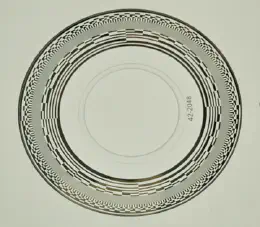
An incremental encoder disc carries equally spaced lines around its circumference plus a separate index (Z) mark. The readhead outputs two signals 90° apart (A and B) — as square waves or as analog sine/cosine for interpolation — and the controller counts them to measure how far, how fast and in which direction the shaft turns. After power-up the system homes on the Z pulse.
Also searched as: incremental encoder disk · incremental code wheel · quadrature encoder disc · A/B/Z code disc · sin/cos encoder disc
- Incremental track + Z index track
- Square-wave (A/B) or sine/cosine patterns
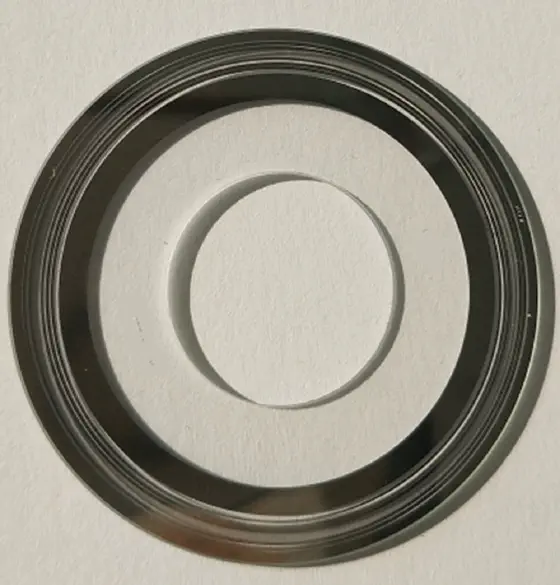
- Glass (chrome on glass), reflective stainless steel or PC substrates
- Line count, reading radius and index position to drawing
- 100% AOI on every disc
Specifications
| Parameter | Incremental Encoder Disc |
|---|---|
| Substrates | Optical glass (chrome on glass) · stainless steel (reflective) · polycarbonate (PC) |
| Optical path | Transmissive or reflective |
| Tracks | Incremental (A/B) + index (Z); sine/cosine on request |
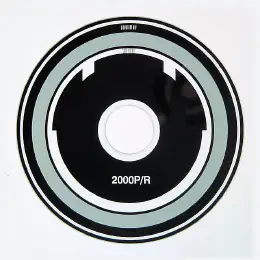
| Line count | To your drawing — example in production: 2000 P/R |
| Pattern process | Photolithography + etching |
| Contour machining | Laser OD cutting · laser bore machining |
| Inspection | 100% AOI machine vision; vision measuring machine; optical density / reflectance testing |
| Capacity | About 30,000 discs per day (all product lines combined) |
What we can customize
- Line count and reading radius
- Index (Z) position and width
- Duty cycle (line : gap ratio)
- Outer diameter, bore and thickness
- Centering reference ring and alignment marks
Ordering information
| Quotation | Engineer reviews your drawing for manufacturability, then quotes with sample and production lead times |
|---|---|
| Minimum order quantity (MOQ) | 100 pcs |
| Standard lead time | 5–7 days (confirmed in the quotation) |
| Certifications | ISO 9001 (since 2012) · ISO 14001 |
| Manufacturer | ENC7 — Langfang Jingzheng Optoelectronic Technology Co., Ltd., factory-direct since 2007 |
Typical applications
How an incremental disc works
The disc carries, say, 2500 equally spaced lines. A and B are 90° apart, so the controller reads direction from which channel leads and counts every edge (×4): 2500 × 4 = 10,000 counts per revolution. Sin/cos discs are interpolated electronically to far higher resolution. Because the disc tells you how far the shaft has turned rather than where it is, the system homes on the Z index after power-up. If you need position immediately at power-up, see our absolute encoder disc.
Choosing a substrate
- Chrome-on-glass — highest line counts and thermal stability
- Metal / stainless steel — reflective, thin and shock-resistant
- PC (polycarbonate) — high volume, moderate resolution, lowest cost
Send your drawing to sales@enc7.com or request a quote.
Glass vs. reflective metal vs. PC encoder discs
| Criterion | Glass (chrome on glass) | Reflective metal | PC (polycarbonate) |
|---|---|---|---|
| Typical optical path | Transmissive | Reflective (source and detector on the same side) | Transmissive |
| High line counts / absolute multi-track | Easiest | Possible, limited by etching and coating | Moderate resolution |
| Thermal expansion (approx.) | Low — about 3.3 (borosilicate) to 9 (soda-lime) ×10⁻⁶/K | Higher — stainless steel about 16–17 ×10⁻⁶/K | Highest — about 65–70 ×10⁻⁶/K |
| Shock and vibration | Sensitive to drops and impact | Very good — does not shatter | Good — tough, not brittle |
| Encoder height | Needs space on both sides | Can be very thin | Needs space on both sides |
| Relative cost | Higher | Lower than glass | Lowest |
| Best for | CNC, rotary tables, metrology, high-resolution servo | Robot joints, slim servo motors, hollow-shaft encoders | High-volume, cost- and weight-sensitive encoders |
Full comparison: Reflective metal or glass encoder disc? How to choose
Quality control on every disc
- 100% AOI — automated optical inspection of graduation integrity, pitch and surface defects (scratches, spots, chips).
- Vision measuring machine — critical dimensions such as outer diameter, bore and pattern-to-bore concentricity are verified.
- Optical density testing — transparent and opaque areas are measured on transmissive discs.
- ISO 9001 quality management system, certified since 2012; ISO 14001 environmental management system.
- MOQ 100 pcs, standard lead time 5–7 days.
Frequently asked questions
How do I convert line count into resolution?
Is a sine/cosine disc incremental or absolute?
Why are the lines and gaps usually 1:1?
What do I need to specify for an incremental disc?
Downloads
- Incremental Encoder Disc datasheet (PDF) · available on request: sales@enc7.com
- RFQ checklist: 20 parameters to send with your drawing
Last updated 21 October 2026 · ENC7 Engineering Team