Transmissive · Polycarbonate
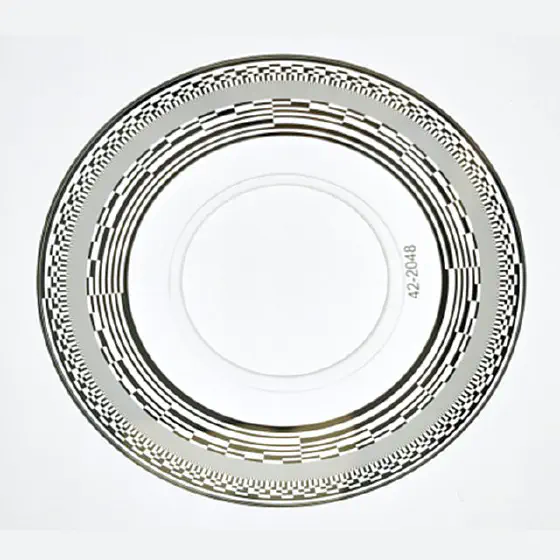
PC (polycarbonate) encoder disc
A PC encoder disc is a transmissive code wheel made of polycarbonate (PC) engineering plastic, carrying a pattern of clear and opaque graduations. Compared with glass and metal, PC is lighter, tougher and does not shatter, and it costs less — a good fit for weight- and cost-sensitive encoders built in large volumes.
Also searched as: plastic encoder disc · polycarbonate code wheel · plastic codewheel · PC encoder disk
- Polycarbonate substrate — lightweight, tough, not brittle
- Lower cost, suited to high-volume production
- Transmissive graduations with uniform pitch and clear contrast
- Custom outer diameter, bore and line count
- Laser-cut contour; 100% AOI inspected
Specifications
Values marked [spec TBD] are being finalized. Exact figures depend on your drawing — ask for the current datasheet.
| Parameter | PC Encoder Disc |
|---|---|
| Substrate | Polycarbonate (PC) |
| Optical path | Transmissive |
| Encoding | [spec TBD] |
| Key properties | Lightweight, tough, shatter-resistant, low cost |
| Thermal expansion (typical PC) | About 65–70×10⁻⁶/K (typical literature value) |
| Contour machining | Laser OD cutting · laser bore machining |
| Outer diameter range | [spec TBD] |
| Bore range | [spec TBD] |
| Thickness | [spec TBD] |
| Line count range | [spec TBD] |
| Minimum line width / tolerance | [spec TBD] |
| Operating temperature | [spec TBD] |
| Inspection | 100% AOI machine vision; vision measuring machine; optical density testing |
| Capacity | About 30,000 discs per day (all product lines combined) |
What we can customize
- Outer diameter and bore to drawing
- Line count
- Other options [TBD: confirm track/index options for PC]
Ordering information
| Quotation | Engineer reviews your drawing for manufacturability, then quotes with sample and production lead times |
|---|---|
| Minimum order quantity (MOQ) | [TBD: MOQ] |
| Sample lead time | [TBD: sample lead time] |
| Production lead time | [TBD: production lead time] |
| Packaging | [TBD: packaging standard] |
| Trade terms / payment | [TBD: Incoterms and payment terms] |
Typical applications
- Office & consumer equipment
- Light-duty servo & stepper motors
- Automation position feedback
- High-volume, cost-sensitive encoders
Where PC discs make sense
PC discs trade some thermal stability for weight, toughness and cost. They suit encoders that run in a controlled temperature range and are produced in large quantities. If your application sees a wide temperature range or needs very high resolution, compare with a glass encoder disc.
Glass vs. reflective metal vs. PC encoder discs
| Criterion | Glass (chrome on glass) | Reflective metal | PC (polycarbonate) |
|---|---|---|---|
| Typical optical path | Transmissive | Reflective (source and detector on the same side) | Transmissive |
| High line counts / absolute multi-track | Easiest | Possible, limited by etching and coating | Moderate resolution |
| Thermal expansion (approx.) | Low — about 3.3 (borosilicate) to 9 (soda-lime) ×10⁻⁶/K | Higher — stainless steel about 16–17 ×10⁻⁶/K | Highest — about 65–70 ×10⁻⁶/K |
| Shock and vibration | Sensitive to drops and impact | Very good — does not shatter | Good — tough, not brittle |
| Encoder height | Needs space on both sides | Can be very thin | Needs space on both sides |
| Relative cost | Higher | Lower than glass | Lowest |
| Best for | CNC, rotary tables, metrology, high-resolution servo | Robot joints, slim servo motors, hollow-shaft encoders | High-volume, cost- and weight-sensitive encoders |
Full comparison: Reflective metal or glass encoder disc? How to choose
Quality control on every disc
- 100% AOI — automated optical inspection of graduation integrity, pitch and surface defects (scratches, spots, chips).
- Vision measuring machine — critical dimensions such as outer diameter, bore and pattern-to-bore concentricity are verified.
- Optical density testing — transparent and opaque areas are measured on transmissive discs.
- ISO 9001 quality management system, certified since 2012.
Frequently asked questions
When is a PC encoder disc the right choice?
What should I check when using a PC disc over a wide temperature range?
Is a PC disc the same as a Mylar film disc?
Downloads
- PC Encoder Disc datasheet (PDF) — [TBD: datasheet file] · available on request now: sales@enc7.com
- RFQ checklist: 20 parameters to send with your drawing
Last updated 1 January 0001 · ENC7 Engineering Team